Data story · Counted 25 November 2026
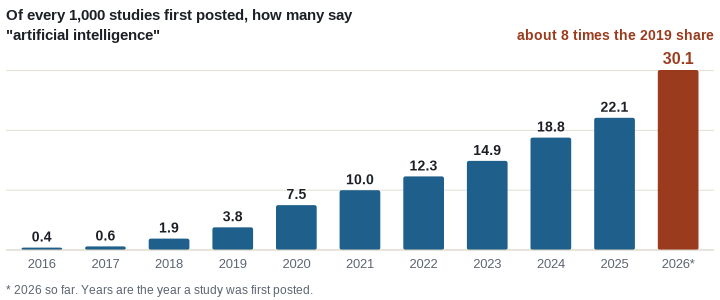
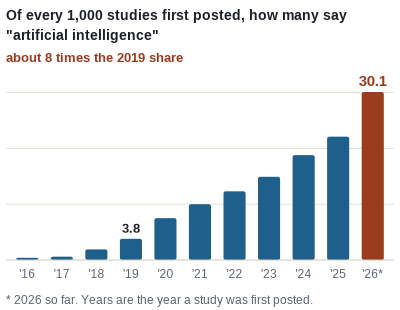
Of every 1,000 studies added to ClinicalTrials.gov so far in 2026, 30 say "artificial intelligence". In 2019, 4 did.
Updated 25 November 2026. This count now comes from reading every study record first posted in each year, not from a search. An earlier version of this page, published the same day, counted 1,000 studies for 2026 and 71 for 2019; its search matched lower-case text only and did not read detailed descriptions or eligibility criteria.
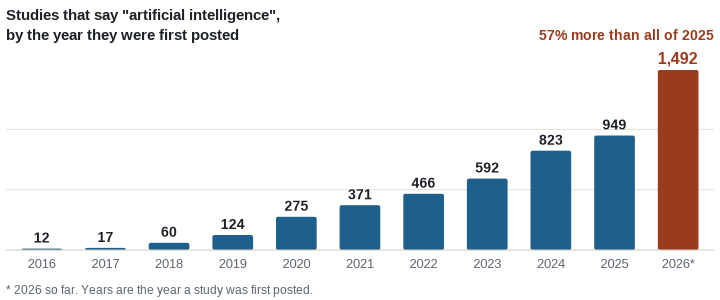
That is 1,492 of the 49,557 studies first posted on the U.S. government's registry of clinical studies so far this year, against 949 in all of 2025 and 124 in 2019.[1] The words in a study's record do not say what part AI plays in it.
Already past every full year
1,492
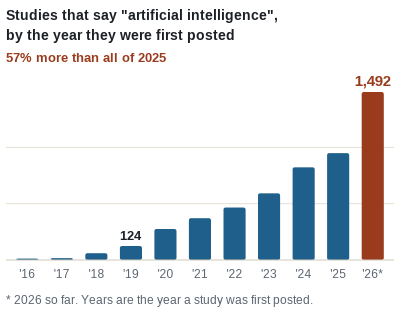
studies that say "artificial intelligence" were first posted between 1 January and the registry's data of 24 November 2026, 57% more than in all of 2025 (949).[1] The count has risen every year since 2014.
What kind of studies
Of the 1,492 so far in 2026, the registry lists 821 as interventional studies, where people are given a treatment or another intervention, and 671 as observational studies, where they are only watched or measured.[1]
Who runs them
The registry puts each study's lead sponsor in a class. For the 2026 studies: 1,322 in the class it calls "Other", 95 in "Industry", 65 in "Other government" and 6 in "Network". 2 are in its class for the National Institutes of Health and 2 in its class for other U.S. federal agencies.[1]
183 of the 1,492 list at least one study site in the United States; in 2025 it was 160 of 949.[1] The registry is run by the U.S. National Library of Medicine, and studies from any country can be listed on it.
By year
| Year first posted | "artificial intelligence" | All studies | Per 1,000 | "machine learning" | "large language model" |
|---|---|---|---|---|---|
| 2016 | 12 | 27,785 | 0.4 | 28 | 0 |
| 2017 | 17 | 29,175 | 0.6 | 51 | 0 |
| 2018 | 60 | 30,945 | 1.9 | 102 | 0 |
| 2019 | 124 | 32,508 | 3.8 | 154 | 0 |
| 2020 | 275 | 36,718 | 7.5 | 266 | 2 |
| 2021 | 371 | 37,011 | 10.0 | 300 | 1 |
| 2022 | 466 | 38,021 | 12.3 | 381 | 2 |
| 2023 | 592 | 39,701 | 14.9 | 419 | 10 |
| 2024 | 823 | 43,668 | 18.8 | 531 | 31 |
| 2025 | 949 | 42,962 | 22.1 | 531 | 103 |
| 2026, so far | 1,492 | 49,557 | 30.1 | 637 | 237 |
Data: studies-by-year.csv
How it was counted
- Every study was read. For each year from 2012 to 2026, a program fetched from the registry's public API every study first posted in that year, 495,351 records in all, and tested each one's own text for the phrase.[1] The registry's search was not used for the count.
- A study counts when that text contains the phrase itself, in any capitalisation, with a space or a hyphen between the words. The text read: titles, summary, detailed description, keywords, conditions, interventions, study arms, outcome measures, eligibility criteria, and the names of the sponsor and collaborators.
- All studies per year: the number of records read for that year. It equals the registry's own total for the year.
- What the first version missed for 2026: 339 studies that write the phrase only with a capital letter, and 154 that use it in lower case only in the detailed description or the eligibility criteria. One study of the first version is no longer counted, because its only use of the phrase is outside the text read.
- Why not a better search: the registry's search was tried again at its widest, four searches per phrase and year, each result then read by the program. For 2026 it found 1,491 of the 1,492 "artificial intelligence" studies, but only 178 of the 237 that say "large language model".
Limits
- The phrase can sit anywhere in the text read: a title, the summary, the description, a keyword or the name of a tool. It does not say whether AI is the thing being tested. 2 of the 2026 studies carry it only in the name of a sponsor or collaborator.
- Studies that use the phrase only outside the text read are not counted. A search of each of the 205 text fields the registry lists found 69 of them for 2026 (58 in the citation of a paper the record lists, 4 in an index term the registry adds, 3 in a data-sharing statement, 2 in a job title and an affiliation, 1 in a note on stored samples, 1 in a job title) and 20 for 2019 (14 in the citation of a paper the record lists, 4 in an index term the registry adds, 1 in results posted after the study, 1 in the name of a study site). That check relies on the registry's search, so it can miss some.
- The registry changes every day: records are added and edited. A count read on another day will differ.
- 2026 is not over. The counts are by the date a study was first posted, as of the registry's data of 24 November 2026.
- A study on the registry is a plan or a record of a study. Being listed is not a finding, and it is not an approval of anything.
More on the federal AI picture: "Artificial intelligence" in NIH projects · "Artificial intelligence" in the Federal Register · "ChatGPT" in NSF award texts · 3,928 federal grants mention AI in fiscal 2025.
Sources
- U.S. National Library of Medicine, ClinicalTrials.gov, through its public API, version 2: every study record first posted from 2012 to 2026, with its study type, lead sponsor class and countries of study sites. Read and counted by this site. Read 25 November 2026; registry data as of 24 November 2026.