Guide · Generative AI
Generative AI in government
How many federal uses of generative AI agencies have put on the public record, how far along they are, what they are for, and the rules that apply.
What counts as generative AI here
Each year federal agencies list the ways they use AI. In the 2025 list, every use case carries one label for the kind of AI it relies on. The label for this guide is defined by OMB as "AI that generates new or synthetic content (e.g., images, videos, audio, text, code)".[2]
The instructions tell agencies that one use case may rely on several kinds of AI and that they should pick the label that fits best.[2] So the counts below are counts of the agencies' own choice of label, not an outside audit of the systems.
How many
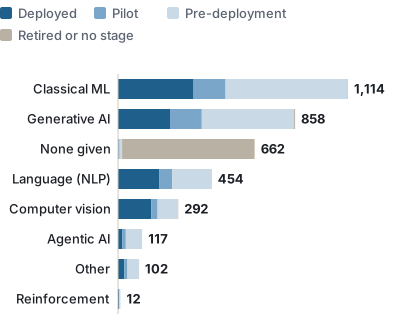
858 of the 3,611 use cases in the 2025 inventory are labelled generative AI.[1] Of those, 252 are marked deployed, 154 are pilots and 447 are still before deployment.[1] Only classical machine learning, with 1,114, is more common.[1]
A newer label sits beside it: 117 use cases are labelled agentic AI, systems that "perform tasks or make decisions autonomously with minimal human intervention" in OMB's words. 20 of them are marked deployed.[1][2]
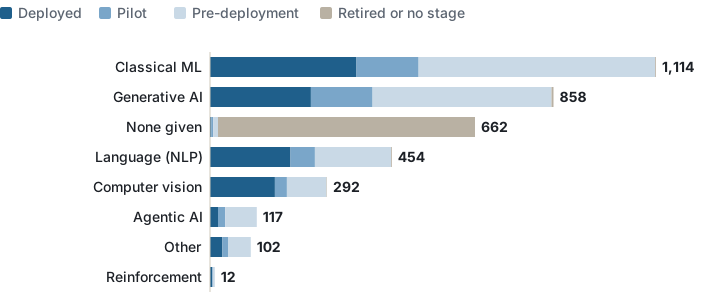
| Type of AI | Deployed | Pilot | Pre-deployment | Retired or no stage | Total |
|---|---|---|---|---|---|
| Classical ML | 366 | 155 | 591 | 2 | 1,114 |
| Generative AI | 252 | 154 | 447 | 5 | 858 |
| (no classification given) | 3 | 5 | 12 | 642 | 662 |
| NLP | 201 | 61 | 190 | 2 | 454 |
| Computer Vision | 162 | 30 | 99 | 1 | 292 |
| Agentic AI | 20 | 18 | 79 | 0 | 117 |
| Other | 31 | 15 | 56 | 0 | 102 |
| Reinforcement Learning | 5 | 2 | 5 | 0 | 12 |
What agencies use it for
Agencies also file each use case under a topic. For the generative AI use cases the largest are IT with 223 and administrative functions with 206, then service delivery with 64, science with 64, law enforcement with 54 and health and medical with 45.[1]
33 agencies list at least one generative AI use case. The longest lists are the Department of Energy with 150, Health and Human Services with 140, Justice with 89 and the Treasury with 78.[1] A long list says what an agency chose to report; it does not rank how much each agency relies on the tools.
Data: generative-ai-by-topic-2025.csv · generative-ai-by-agency-2025.csv
How fast it grew
The Government Accountability Office compared the inventories of 11 agencies across two years. At those agencies, all reported AI use cases went from 571 in 2023 to 1,110 in 2024, and generative AI use cases went from 32 to 282.[4]
Those figures cover a different set of agencies and an older reporting form than the 2025 count above, so the two should not be lined up as one series.[4][3]
The rules
The main instruction is OMB Memorandum M-25-21, issued on 3 April 2025, which rescinded and replaced the earlier memo M-24-10.[5] It asked agencies to write, within 270 days, a policy that "sets the terms for acceptable use of generative AI" and sets safeguards and oversight for it.[5] A companion memo, M-25-22, covers how agencies buy AI.[6] OMB's list of memoranda shows no later memo replacing M-25-21.[10]
Executive Order 14319, signed on 23 July 2025, set two "Unbiased AI Principles" for the large language models the government buys.[7][8] OMB's Memorandum M-26-04 of 11 December 2025 tells agencies how to apply them.[8]
On 14 August 2025 the General Services Administration launched USAi, which it describes as "a secure generative artificial intelligence evaluation suite" that agencies can use at no cost to them, with chat, code generation and document summarization.[9]
Using it well
The earlier version of this site ran a dozen how-to posts on chat assistants and prompt writing. They are retired. What still holds, and what the public-sector rules above point toward, fits in a short list:
- Say what the task is and what the answer will be used for.
- Give the tool the source material, and ask it to point to the passage behind each statement.
- Check every number and name against the source before it leaves your desk.
- Keep personal and sensitive data out unless your agency's policy allows it for that tool.
- Write down which tool, which version and which prompt produced a result someone will rely on.
What the count leaves out
The 2025 inventory excludes AI used in national security systems or the intelligence community, AI used for basic or applied research, and use cases of the Department of War.[3] Common tasks done with commercial off-the-shelf products are reported in a separate consolidated file, so generative AI built into everyday office software is mostly outside the 858.[3]
See also: AI in the public sector for the whole inventory, and the data story 3,611 uses of AI on the federal list.
Sources
- Office of Management and Budget, 2025 Federal Agency AI Use Case Inventory, file of individually reported use cases (3,611 rows; the repository says "as of April 13, 2026"), counted by this site: 2025_individually_reported_AI_use_cases.csv. Read 28 October 2026.
- Office of Management and Budget, 2025 inventory data dictionary. Read 28 October 2026.
- Office of Management and Budget, 2025 Federal Agency AI Use Case Inventory repository, README (summary, submission schedule and exclusion criteria). Read 28 October 2026.
- U.S. Government Accountability Office, GAO-25-107653, Artificial Intelligence: Generative AI Use and Management at Federal Agencies, 29 July 2025. Read 28 October 2026.
- OMB Memorandum M-25-21, Accelerating Federal Use of AI through Innovation, Governance, and Public Trust, 3 April 2025. Read 28 October 2026.
- OMB Memorandum M-25-22, Driving Efficient Acquisition of Artificial Intelligence in Government, 3 April 2025. Read 28 October 2026.
- Federal Register, Executive Order 14319, Preventing Woke AI in the Federal Government, signed 23 July 2025. Read 28 October 2026.
- OMB Memorandum M-26-04, Increasing Public Trust in Artificial Intelligence Through Unbiased AI Principles, 11 December 2025. Read 28 October 2026.
- U.S. General Services Administration, news release, GSA Launches USAi to Advance White House "America's AI Action Plan", 14 August 2025. Read 28 October 2026.
- OMB, list of memoranda (checked for any later memo replacing M-25-21; none listed through M-26-19). Read 28 October 2026.
How this page was counted: the classification and stage columns of OMB's file, one row per use case, read on 28 October 2026. The CSV files beside this page carry the counts, the source address and the read date.