Guide · Terms
AI explained: the terms the federal inventory uses
A glossary of the words in OMB's federal AI use case inventory, each defined the way OMB's own data dictionary and memorandum define it, with the number of the 3,611 use cases that carry each value. No textbook or vendor definitions.
What counts as AI
The inventory is compiled under OMB Memorandum M-25-21, and that memorandum takes its definition of artificial intelligence from section 238(g) of the National Defense Authorization Act for fiscal year 2019.[4][3] It adds four points: the definition covers machine learning, including deep learning and supervised, unsupervised and semi-supervised approaches, reinforcement learning, transfer learning and generative AI; it does not cover robotic process automation or systems whose behaviour "is defined only by human-defined rules"; no system is too simple to qualify; and it includes systems with and without human oversight.[4] An "AI system" takes its meaning from the Advancing American AI Act, which excludes "any common commercial product within which artificial intelligence is embedded"; an "AI model" is a component that produces outputs by computational, statistical or machine-learning techniques.[4]
The inventory leaves out AI in national security systems or the intelligence community, research AI not meant for agency use, and the use cases of the Department of War, as OMB's README names it (the Department of Defense); common tasks done with commercial off-the-shelf products go into a separate consolidated file.[3]
Use case, agency, bureau
A row of the file is one use case, with a name and an identifier meant to persist from year to year; the bureau column is the "specific organization(s) within the agency responsible", as the agency wrote it.[1] OMB recoded answers that plainly meant a valid option and otherwise left them as written, which is why some columns carry values the dictionary does not list.[1]
The four stages
Every use case is meant to carry one of four stages. In the dictionary's words, a pre-deployment use case "is in a development or acquisition status"; a pilot "has been deployed in a limited test or pilot capacity"; a deployed one is being used "to support the functions or mission of an agency"; a retired one was in the prior year's inventory and has since been discontinued.[1] In the file, 1,479 rows are pre-deployment, 1,040 deployed, 440 pilots and 314 retired; 338 carry no stage at all.[2] Topic, classification and the problem solved are asked only of pre-deployment, pilot and deployed use cases, and the vendor, authorization, data and code questions only of pilots and deployed ones, so an empty cell is often an unasked question.[1]
| Value, as the file gives it | Use cases | Of which deployed | In the dictionary | The dictionary's wording |
|---|---|---|---|---|
| Pre-deployment | 1,479 | 0 | yes | The use case is in a development or acquisition status. |
| Pilot | 440 | 0 | yes | The use case has been deployed in a limited test or pilot capacity. |
| Deployed | 1,040 | 1,040 | yes | The use case is being actively authorized or utilized to support the functions or mission of an agency. |
| Retired | 314 | 0 | yes | The use case was reported in the agency’s prior year’s inventory, but its development and/or use has since been discontinued. |
| No answer | 338 | 0 | no |
Data: terms-development-stage-2025.csv
The six kinds of AI
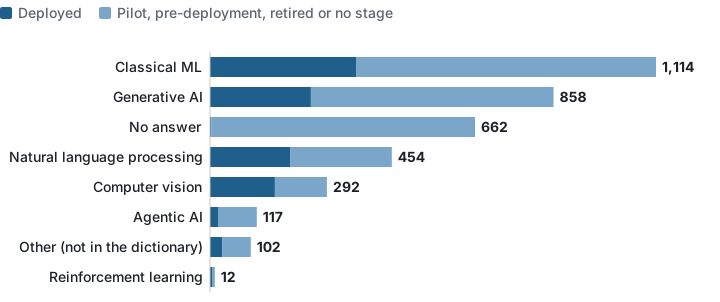
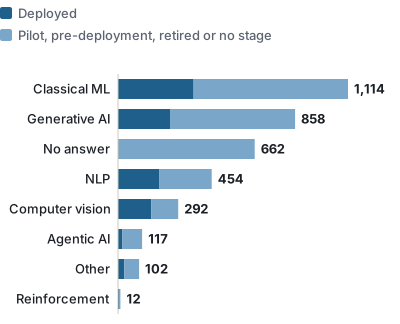
Agencies choose the one classification "that most closely aligns" with each use case, from six: classical or predictive machine learning, models trained on data to predict or classify; generative AI, which generates new or synthetic content; natural language processing; computer vision; agentic AI, which acts "autonomously with minimal human intervention"; and reinforcement learning, trained "through trial and error using rewards and penalties".[1] Classical machine learning is the largest share with 1,114 use cases, then generative AI 858, natural language processing 454, computer vision 292, agentic AI 117 and reinforcement learning 12.[2] A further 102 rows say "Other", which the dictionary does not offer here, and 662 give no answer.[2][1]
| Value, as the file gives it | Use cases | Of which deployed | In the dictionary | The dictionary's wording |
|---|---|---|---|---|
| Classical ML | 1,114 | 366 | yes | Models trained on data to make predictions or classifications based on identified patterns or relationships. |
| Generative AI | 858 | 252 | yes | AI that generates new or synthetic content (e.g., images, videos, audio, text, code). |
| No answer | 662 | 3 | no | |
| NLP | 454 | 201 | yes | AI that processes, interprets, and shares information in human language. |
| Computer Vision | 292 | 162 | yes | AI that processes and interprets visual data (e.g., images and videos). |
| Agentic AI | 117 | 20 | yes | AI systems that perform tasks or make decisions autonomously with minimal human intervention. |
| Other | 102 | 31 | no | |
| Reinforcement Learning | 12 | 5 | yes | AI trained through trial and error using rewards and penalties to optimize decision-making policies. |
High-impact
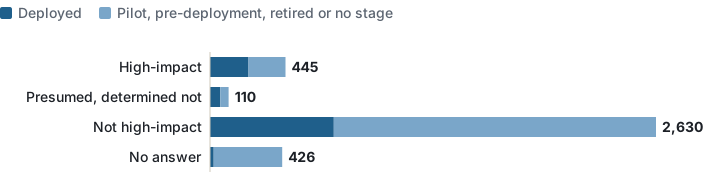
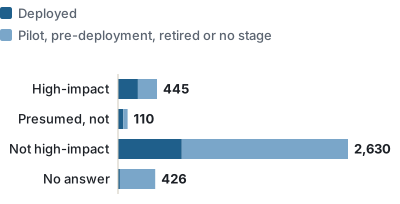
M-25-21 defines high-impact AI as AI with an output that "serves as a principal basis for decisions or actions" with a legal, material, binding or significant effect on one of six things: civil rights, civil liberties or privacy; access to education, housing, insurance, credit, employment and other programs; access to critical government services; health and safety; critical infrastructure or public safety; or strategic assets.[4] A separate section lists purposes presumed high-impact, from safety-critical infrastructure to benefits adjudication, and calls the list not exhaustive.[4] The inventory asks for one of three answers, with a justification when a presumed high-impact use is determined not to be.[1] 445 use cases are marked high-impact, 110 presumed and determined not, 2,630 not high-impact and 426 unanswered.[2]
For a deployed high-impact use case the memorandum's minimum practices become columns: testing, an impact assessment, an independent review, monitoring, operator training, a fail-safe, an appeal process and public consultation, each answered yes, in progress, not applicable or waived by the chief AI officer.[1][4] Of the 227 deployed high-impact use cases, 125 answer on testing (81 in progress and 44 yes), and 102 leave it empty.[2]
Data: terms-high-impact-2025.csv · terms-high-impact-practices-2025.csv
Topic areas
The dictionary offers fifteen topic areas, some shortened in the file ("Procurement and Financial Management" becomes "Procurement and Finance Mgmt").[1] All 15 appear; so do 4 values the dictionary does not list, kept as agencies wrote them, covering 56 use cases.[2][1] Science is the largest topic with 758 use cases; 603 rows carry no topic.[2]
| Value, as the file gives it | Use cases | Of which deployed | In the dictionary | The dictionary's wording |
|---|---|---|---|---|
| Science | 758 | 87 | yes | Science |
| No answer | 603 | 3 | no | |
| Admin Functions | 424 | 168 | yes | Administrative Functions |
| IT | 394 | 124 | yes | Information Technology |
| Law Enforcement | 285 | 179 | yes | Law Enforcement |
| Health and Medical | 272 | 155 | yes | Health and Medical |
| Other | 173 | 75 | yes | Other |
| Service Delivery | 150 | 41 | yes | Service Delivery |
| Energy and Environment | 131 | 26 | yes | Energy and the Environment |
| Procurement and Finance Mgmt | 90 | 41 | yes | Procurement and Financial Management |
| Transportation | 79 | 23 | yes | Transportation |
| Benefits Processing | 56 | 26 | yes | Government Benefits Processing |
| Cybersecurity | 53 | 22 | yes | Cybersecurity |
| HR | 46 | 25 | yes | Human Resources |
| Other, Economic & Financial | 34 | 14 | no | |
| Emergency Mgmt | 33 | 11 | yes | Emergency Management |
| Other - Applied Mathematical Sciences | 13 | 11 | no | |
| International Affairs | 8 | 6 | yes | International Affairs |
| Administrative functions | 6 | 3 | no | |
| Other (use other text field) | 3 | 0 | no |
Data: terms-topic-area-2025.csv
Who built it, and the yes/no questions
Pilots and deployed use cases are asked whether the system was bought from a vendor, developed in-house or both. Of the rows that answer, 594 say vendor, 581 in-house and 429 both, more than the 1,480 pilot and deployed rows, since 160 answers are on pre-deployment or retired rows; 2,007 give no answer.[1][2] The same rows answer three yes/no questions (240 answers to the first sit on pre-deployment or retired rows): personally identifiable information as OMB Circular A-130 defines it (360 yes, 1,151 no), an authorization to operate (787 yes, 755 no) and custom-developed code (706 yes, 1,006 no).[1][2] A withholding column records 20 rows citing a disclosure risk and 4 a legal prohibition; they stay in the public file with what the agency could share.[2][3]
Data: terms-contracting-usage-2025.csv · terms-yes-no-questions-2025.csv · terms-withheld-2025.csv
NIST's words
NIST's AI Risk Management Framework of January 2023 describes an AI system as an engineered or machine-based system that can "generate outputs such as predictions, recommendations, or decisions", after OECD and ISO wording.[5] It names seven characteristics of trustworthy AI, valid and reliable, safe, secure and resilient, accountable and transparent, explainable and interpretable, privacy-enhanced, and fair with harmful bias managed, and four functions: govern, map, measure and manage.[5]
The earlier version of this site ran five explainers on what AI is, its types, its jargon and reinforcement learning. They are retired.
Counting caveats
- Each value is one choice by the reporting agency, recoded by OMB only where the intent was plain; the counts describe the file, not the systems.[1]
- Empty cells mix questions not asked of a stage with questions left unanswered.[1]
- The rows without a stage all belong to 3 agencies (Department of Commerce, Tennessee Valley Authority, Department of Education), every one of whose rows lacks one; together they are the 338 stageless rows.[2]
- The dictionary's wording, and one agency-written topic value, are shown in the tables with dashes rendered as commas; the CSV files carry them as written.[1]
See also: AI in the public sector, Generative AI in government, Data science in government, AI in government IT and cybersecurity, and the data story 3,611 uses of AI on the federal list.
Sources
- Office of Management and Budget, 2025 inventory data dictionary. Read 28 October 2026.
- Office of Management and Budget, 2025 Federal Agency AI Use Case Inventory, file of individually reported use cases (3,611 rows; the repository says "as of April 13, 2026"), counted by this site: 2025_individually_reported_AI_use_cases.csv. Read 28 October 2026.
- Office of Management and Budget, 2025 Federal Agency AI Use Case Inventory repository, README (summary, submission schedule and exclusion criteria). Read 28 October 2026.
- OMB Memorandum M-25-21, Accelerating Federal Use of AI through Innovation, Governance, and Public Trust, 3 April 2025. Read 29 October 2026.
- National Institute of Standards and Technology, Artificial Intelligence Risk Management Framework (AI RMF 1.0), NIST AI 100-1, January 2023. Read 29 October 2026.
How this page was counted: one row per use case in OMB's file, read on 28 October 2026; for each multiple-choice column (development_stage, is_high_impact, classification, topic_area, contracting_usage, is_withheld, has_pii, have_ato, has_custom_code and the eight hi_ practice columns) the values are counted exactly as the file gives them, surrounding spaces removed, with an empty cell counted as "no answer"; "in the dictionary" means the value, or the shorthand code OMB maps it to, is a valid selection for that column in OMB's data dictionary, read the same day. Definitions are quoted from the dictionary and from M-25-21's definitions section, read on 29 October 2026. README.txt beside the CSV files repeats the rule.