Guide · Defense
AI in defense
The federal AI inventory leaves the Department of Defense out. What can be counted instead: the department's own strategy, its AI office, GAO's audits, the defense authorization acts and the budget overview.
Why the inventory has no defense rows
OMB's 2025 Federal Agency AI Use Case Inventory is the public record this site counts for every other field. Its exclusion criteria list four things that are out of scope, and one of them is "Department of War use cases", the name the department now uses for itself on its AI office's site;[7] the others are AI in national security systems or the intelligence community, AI used for basic or applied research, and use cases whose release would conflict with law or policy.[1]
The file bears that out. It holds 3,611 use cases from 41 agency codes, and none of them is the department: no row carries an agency code of DOD or WAR, no agency name contains "Defense" or "War", and no bureau column names the department, the Army, the Navy, the Air Force, the Marine Corps or the Space Force.[2] The one row whose bureau column reads exactly "DOD" belongs to the CFTC, which uses that code for a division of its own.[2] So every count of "federal AI" drawn from the inventory, including the 3,611 on this site, is a count without the Department of Defense.
Data: defense-rows-in-inventory-2025.csv (the tests and their results) · inventory-agencies-2025.csv (the 41 agencies in the file)
The counts that do exist
Two numbers from the department's own inventories have reached the public record through the Government Accountability Office. In March 2022 GAO reported that the department's April 2021 AI baseline inventory "contained 685 project and line item accounts that include AI-related activities", 135 of them also in the fiscal year 2021 information technology budget submission, and that the number of activities the inventory left out "could not be estimated".[3] In October 2026 GAO reported that the department "reported 378 AI use cases across the department", drawn from a January 2025 inventory list kept by the Chief Digital and Artificial Intelligence Office, and added that there are probably more.[4]
| Count | What was counted | Inventory | Reported in |
|---|---|---|---|
| 685 | project and line item accounts that include AI-related activities | DOD AI baseline inventory, April 2021 | GAO-22-105834 (2022) |
| 378 | AI use cases | CDAO inventory list, January 2025 (DOD reported the same count in February 2026) | GAO-27-107837 (2026) |
The two are not one series. The first counts budget accounts that include AI; the second counts use cases. Both come from lists the department compiled for itself: GAO said the first left out activities whose number could not be estimated, and that the second is probably an undercount.[3][4] For comparison, the Department of Health and Human Services alone lists 447 use cases in OMB's 2025 file, under a different definition again.[2]
Data: dod-ai-counts-gao.csv
The strategy
The department's current statement of intent is the Data, Analytics, and Artificial Intelligence Adoption Strategy, cleared for publication on 27 June 2023 and posted on 2 November 2023.[6] It "builds upon and supersedes the 2018 AI Strategy and the 2020 Data Strategy".[6] Its aim is that "DoD leaders and warfighters will be able to make rapid, well-informed decisions by expertly leveraging high-quality data, advanced analytics, and AI".[6]
It names five outcomes: battlespace awareness and understanding; adaptive force planning and application; fast, precise and resilient kill chains; resilient sustainment support; and efficient enterprise business operations.[6] It sets six goals, from improving foundational data management to expanding digital talent management, and puts the Chief Digital and Artificial Intelligence Office in charge of carrying it out, with components to name an office of primary responsibility within 60 days.[6] It gives no dollar figures and no count of systems.[6]
The AI office
The Chief Digital and Artificial Intelligence Office describes its mission as "accelerating DoW adoption of data, analytics, and artificial intelligence (AI)".[7] Its own timeline says that in 2021 four separate organisations, JAIC, DDS, the CDO and Advana as the timeline abbreviates them, worked on digital transformation; that in 2022 and 2023 they were consolidated as a principal staff assistant; and that in 2024 and 2025 the office was realigned under the Under Secretary of Defense for Research and Engineering.[7]
The office says it launched GenAI.mil for the department's personnel in 2025, with tools certified for controlled unclassified information, and that in 2026 the service reached 1 million unique active users and nearly 40 million prompts.[7] Those are the office's own figures on its own site; no audit of them is on the public record that this page could find.
What GAO found
Three GAO reports on the department's AI work were read for this page, and each ends in recommendations. The March 2022 report made seven, on strategies, the inventory process and collaboration guidance.[3] The December 2023 report said the department "has invested billions of dollars to integrate artificial intelligence into its operations" and made three recommendations on managing its AI workforce; two of them were still open in October 2026.[5][4]
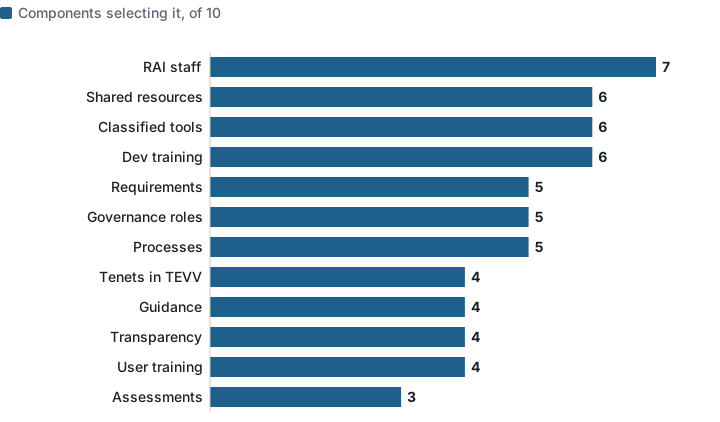
The October 2026 report looked at responsible AI. The department set six tenets in May 2021 and 64 lines of effort in 2022 to put them into practice; in April 2026, 29 of the 64 were incomplete.[4] A 2023 memorandum authorised ten responsible AI positions in the office; three were filled in February 2026.[4] Of ten components GAO surveyed, nine had set up or were setting up oversight bodies, all ten had taken steps to incorporate at least one tenet, and two used the office's responsible AI tools.[4] GAO made two more recommendations.[4]
| Improvement, as GAO words it | Components |
|---|---|
| Access to additional Responsible AI staff or expertise | 7 |
| Sharing of Responsible AI resources and/or best practices | 6 |
| Adding CDAO's Responsible AI tools, or access on classified domains | 6 |
| Additional training for AI or ML developers | 6 |
| Support in developing requirements aligned with Responsible AI tenets | 5 |
| Clearer governance roles and responsibilities | 5 |
| Internal process improvements | 5 |
| Better understanding of embedding tenets into TEVV processes | 4 |
| Detailed guidance on implementing tenets | 4 |
| Greater transparency in data, algorithm, or model characteristics from external organizations | 4 |
| Additional training for AI or ML users | 4 |
| Periodic assessments of alignment with Responsible AI tenets | 3 |
What Congress wrote into law
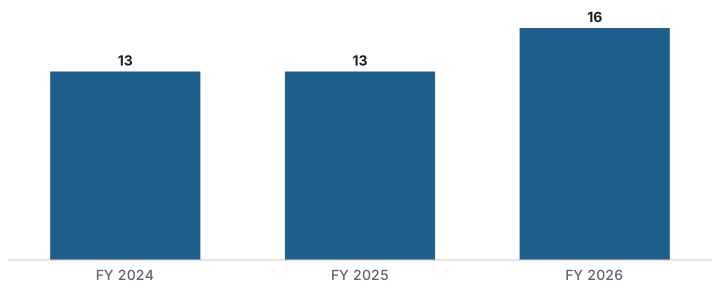
The yearly defense authorization act is where the rules for defense AI are written. Counting the sections whose title names artificial intelligence in each act's table of contents: 13 in the act for fiscal year 2024, 13 for 2025 and 16 for 2026.[8][9][10] The phrase "artificial intelligence" appears 141, 147 and 231 times in the three texts.[8][9][10]
The 2026 act, approved on 18 December 2025, includes these. Section 1532, "Guidance and prohibition on use of certain artificial intelligence", requires the exclusion and removal of "covered artificial intelligence" from the department's systems and devices within 30 days of enactment and bars contractors from using it on department contracts; the term is defined as AI developed by the Chinese company DeepSeek or by High Flyer and entities it owns or funds, with case-by-case waivers.[10] Section 1533 orders a cross-functional team, headed by the Chief Digital and Artificial Intelligence Officer, to build "a standardized assessment framework and governance structure" for the AI models the department uses.[10] Section 1535 establishes an Artificial Intelligence Futures Steering Committee by 1 April 2026, co-chaired by the Deputy Secretary of Defense and the Vice Chairman of the Joint Chiefs of Staff.[10] Section 224 lets the Secretary establish National Security and Defense Artificial Intelligence Institutes at host institutions.[10]
The 2025 act, approved on 23 December 2024, has a section on the "Duties of Chief Digital and Artificial Intelligence Officer Governing Council relating to artificial intelligence models and advanced artificial intelligence technologies" and one on a "Pilot program on use of artificial intelligence for certain workflow and operations tasks".[9] The 2024 act, approved on 22 December 2023, has one on "Control and management of Department of Defense data; establishment of Chief Digital and Artificial Intelligence Officer Governing Council" and one on "Plans, strategies, and other matters relating to artificial intelligence".[8]
The money
The department's Defense Budget Overview for the fiscal year 2026 request, dated June 2025, gives one figure for the field: $13.4 billion for "Autonomous & Remotely Operated Systems (air, land, & sea)" under innovation and modernization.[11] It gives no figure for artificial intelligence as such and none for the AI office.[11] GAO's December 2023 report says only that the department "has invested billions of dollars to integrate artificial intelligence into its operations".[5] No primary document read for this page states a yearly AI budget line, so none is given here.
The earlier version of this site ran essays on AI in the military and data science in military operations. What replaces them is the list above: a strategy, an office, three audits, three statutes and one budget line, each of which can be read and checked.
Limits
- The two inventory counts, 685 and 378, use different definitions and come from the department's own lists, which GAO found incomplete; neither is a count of fielded systems.[3][4]
- The section counts are this site's rule, titles only, so a section that regulates AI under another name is not counted, and a title that names AI in passing is. The count also takes in sections that are not about defense AI: the acts carry titles on the Department of State's Chief Artificial Intelligence Officer and on the intelligence community's use of AI, and those are counted with the rest.[8][9][10]
- The GenAI.mil user and prompt figures are the office's own, on its own site.[7]
- Nothing from news reports, think tanks or vendors is on this page; the record used is the set of documents listed under Sources, each read on 29 October 2026, and a document not listed there was not consulted.
See also: AI in the public sector, Generative AI in government, Data science in government, and the data story 3,611 uses of AI on the federal list.
Sources
- Office of Management and Budget, 2025 Federal Agency AI Use Case Inventory repository, README (summary, submission schedule and exclusion criteria). Read 28 October 2026.
- Office of Management and Budget, 2025 Federal Agency AI Use Case Inventory, file of individually reported use cases (3,611 rows; the repository says "as of April 13, 2026"), counted by this site: 2025_individually_reported_AI_use_cases.csv. Read 28 October 2026.
- U.S. Government Accountability Office, GAO-22-105834, Artificial Intelligence: DOD Should Improve Strategies, Inventory Process, and Collaboration Guidance, 30 March 2022. Read 29 October 2026.
- U.S. Government Accountability Office, GAO-27-107837, Artificial Intelligence: Actions and Opportunities to Implement Responsible Use in DOD, 14 October 2026. Read 29 October 2026.
- U.S. Government Accountability Office, GAO-24-105645, Artificial Intelligence: Actions Needed to Improve DOD's Workforce Management, 14 December 2023. Read 29 October 2026.
- U.S. Department of Defense, Data, Analytics, and Artificial Intelligence Adoption Strategy (PDF, cleared for open publication 27 June 2023, posted 2 November 2023). Read 29 October 2026.
- Chief Digital and Artificial Intelligence Office, About page and home page at ai.mil. Read 29 October 2026.
- Public Law 118-31, National Defense Authorization Act for Fiscal Year 2024, approved 22 December 2023 (govinfo); sections counted by this site. Read 29 October 2026.
- Public Law 118-159, National Defense Authorization Act for Fiscal Year 2025, approved 23 December 2024 (govinfo); sections counted by this site. Read 29 October 2026.
- Public Law 119-60, National Defense Authorization Act for Fiscal Year 2026, approved 18 December 2025 (govinfo); sections counted by this site. Read 29 October 2026.
- Office of the Under Secretary of Defense (Comptroller), Defense Budget Overview, Fiscal Year 2026 Budget Request (PDF), June 2025. Read 29 October 2026.
How this page was counted: every row of OMB's file was tested for a Department of Defense or Department of War agency code, agency name, bureau or use case name, read on 28 October 2026; the three authorization acts' tables of contents were parsed from govinfo's text, one entry per section number, and a section counted when its title contains "artificial intelligence", read on 29 October 2026; the GAO counts and Table 3 were copied from the reports as read on 29 October 2026. The CSV files beside this page carry the counts, the source addresses, the read dates and a README with every rule.