Guide · Service delivery
AI in service delivery
What the agencies that pay benefits, decide claims and answer the public say they use AI for: Social Security, veterans' benefits, the IRS, immigration, passports and visas, Medicare and Medicaid, and student aid. Counted from the public inventory, with GAO's and the IRS's own documents.
The public record
Agencies list their AI use cases each year; OMB compiles them into one public file of 3,611 rows.[3][1] The file has no column for "serves the public", so this guide counts the rows of seven bureaus whose work is paying benefits, deciding claims and answering the public: the Social Security Administration (every bureau), the Veterans Benefits Administration (not the health administration), the Internal Revenue Service, U.S. Citizenship and Immigration Services, the State Department's Bureau of Consular Affairs, the Centers for Medicare and Medicaid Services and Federal Student Aid, by the bureau names in the file.[1]
The customer-experience page on performance.gov says Executive Order 14058 "Directed 17 agencies to take 36 specific actions"; it does not mention AI.[6]
How many
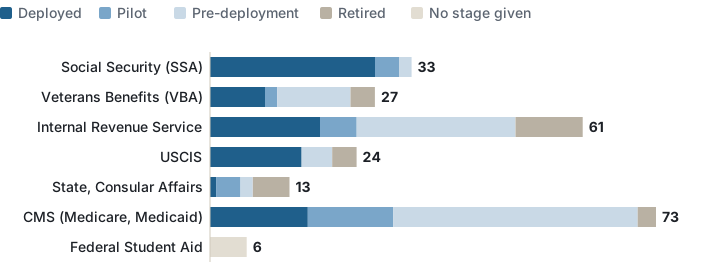
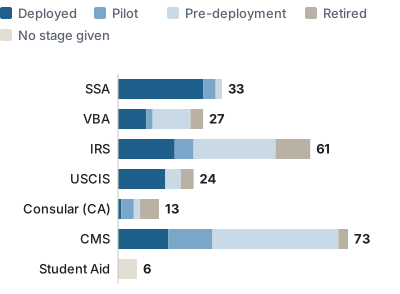
The seven service bureaus list 237 of the 3,611 use cases.[1] Of those, 86 are marked deployed, 30 are pilots, 87 are before deployment, 28 are retired and 6, all of them Federal Student Aid's, carry no stage.[1] So 36% of the set is deployed, against 29% for the whole file, and 33 of the 237 are marked high-impact, against 445 of the 3,611.[1]
| Bureau, as named in the file | Deployed | Pilot | Pre-deployment | Retired | No stage | Total | High-impact |
|---|---|---|---|---|---|---|---|
| SSA (all bureaus) | 27 | 4 | 2 | 0 | 0 | 33 | 9 |
| VA: VBA: Veterans Benefits Administration | 9 | 2 | 12 | 4 | 0 | 27 | 11 |
| TREAS: Internal Revenue Service (IRS) | 18 | 6 | 26 | 11 | 0 | 61 | 3 |
| DHS: USCIS | 15 | 0 | 5 | 4 | 0 | 24 | 8 |
| STATE: CA | 1 | 4 | 2 | 6 | 0 | 13 | 1 |
| HHS: bureaus beginning HHS/CMS | 16 | 14 | 40 | 3 | 0 | 73 | 1 |
| ED: Federal Student Aid | 0 | 0 | 0 | 0 | 6 | 6 | 0 |
| All seven service bureaus | 86 | 30 | 87 | 28 | 6 | 237 | 33 |
| All 3,611 use cases | 1040 | 440 | 1479 | 314 | 338 | 3611 | 445 |
Data: sd-by-bureau-2025.csv
Bureau by bureau
Centers for Medicare and Medicaid Services is the largest of the seven with 73 use cases across the bureaus the file names "HHS/CMS", but 40 of them are before deployment and only 16 are deployed; the deployed rows include "Eligibility & Enrollment Medicare Online (ELMO) Chatbot", "Independent Dispute Resolution (IDR) Eligibility Rules Engine".[1] The IRS lists 61, with 18 deployed; its deployed service-delivery rows are "Identity Verification", "Integrate Word Processor AI for Digitalization", "Machine Translation", "SBSE - Payments Topics Chatbot", "Taxpayer Services Chatbot".[1]
Social Security lists 33, 27 of them deployed, the largest share of the seven.[1] 13 deployed rows are filed under benefits processing, among them "Continuing Disability Review Model", "Duplicate Identification Process", "Handwriting Recognition of Forms; Intelligent Document Processing Platform - Forms Classification and Data Extraction", "Insight".[1] The Veterans Benefits Administration lists 27, 9 deployed and 12 before deployment, and marks 11 high-impact, the largest number in the set.[1] USCIS lists 24, 15 deployed, including "ELIS Card Photo Validation Service", "ELIS Evidence Classifier Service", "PDF Intake (PDFI) for myUSCIS".[1] Consular Affairs lists 13, of which 6 are retired and 4 are pilots, among them a visa-interview language pilot.[1] Federal Student Aid's 6 rows are a chatbot and five generative-AI uses.[1]
What it is for
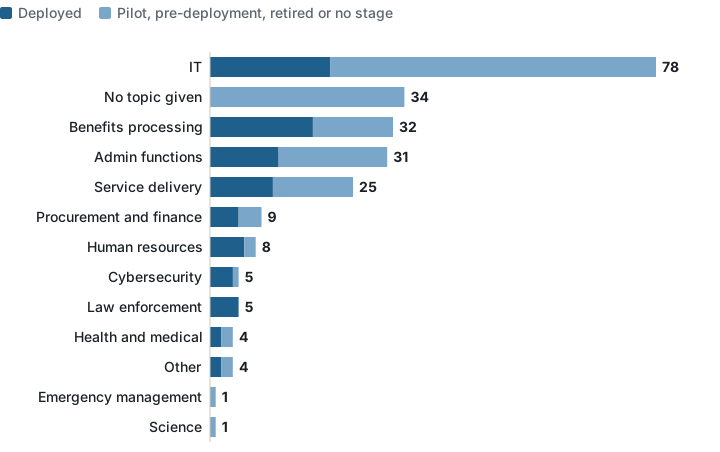
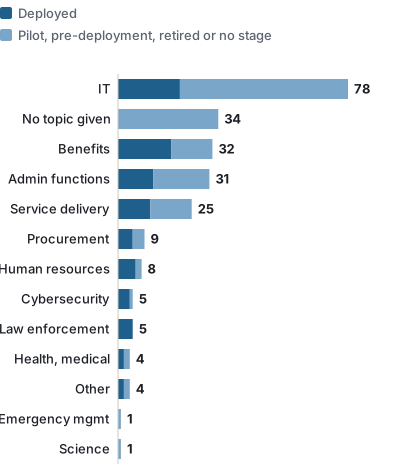
By the topic the agencies chose, IT is the largest with 78 of the 237 rows; benefits processing has 32 (18 deployed), administrative functions 31 and service delivery 25 (11 deployed); 34 rows, the retired and the Student Aid ones, carry no topic.[1][2] Generative AI is the label on 85 rows, classical machine learning on 54 and natural language processing on 42; of the 86 deployed rows, 31 are classical machine learning and 27 generative.[1]
| Bureau | Use case, as named in the file | Topic | Type of AI |
|---|---|---|---|
| U.S. Citizenship and Immigration Services | Automated Name and Date of Birth (DOB) Harvesting Service | Service Delivery | Classical ML |
| U.S. Citizenship and Immigration Services | ELIS Card Photo Validation Service | Service Delivery | Computer vision |
| U.S. Citizenship and Immigration Services | ELIS Evidence Classifier Service | Service Delivery | Classical ML |
| U.S. Citizenship and Immigration Services | PDF Intake (PDFI) for myUSCIS | Benefits Processing | Generative AI |
| Centers for Medicare and Medicaid Services | Independent Dispute Resolution (IDR) Eligibility Rules Engine | Service Delivery | Classical ML |
| Social Security Administration | Continuing Disability Review Model | Benefits Processing | Classical ML |
| Social Security Administration | Customer Insight Tool | Service Delivery | Natural language processing (NLP) |
| Social Security Administration | Duplicate Identification Process | Benefits Processing | Classical ML |
| Social Security Administration | Handwriting Recognition of Forms; Intelligent Document Processing Platform - Forms Classification and Data Extraction | Benefits Processing | Computer vision |
| Social Security Administration | Insight | Benefits Processing | Classical ML |
| Social Security Administration | Intelligent Medical Language Analysis Generation (IMAGEN) | Benefits Processing | Classical ML |
| Social Security Administration | Mobile Wage Reporting | Benefits Processing | Computer vision |
| Social Security Administration | Modernized Development Worksheet (MDW) | Benefits Processing | Classical ML |
| Social Security Administration | Pre-Effectuation Review (PER) / Targeted Denial Review (TDR) Models | Benefits Processing | Classical ML |
| Social Security Administration | Proactive Triage and Analysis of Hearings (PATH) | Benefits Processing | Classical ML |
| Social Security Administration | Quick Disability Determinations Model | Benefits Processing | Classical ML |
| Social Security Administration | Social Security Income (SSI) Redetermination Model | Benefits Processing | Classical ML |
| Social Security Administration | Speech to Text Video Transcription | Benefits Processing | Natural language processing (NLP) |
| Social Security Administration | SSA 800# Public Question & Answer Bot and OIG Hotline recording of fraud, waste and abuse. | Service Delivery | Generative AI |
| Social Security Administration | Vocational Assessment Assistant Tool (VAAT) | Benefits Processing | Generative AI |
| Internal Revenue Service | Identity Verification | Service Delivery | Classical ML |
| Internal Revenue Service | Integrate Word Processor AI for Digitalization | Service Delivery | Classical ML |
| Internal Revenue Service | Machine Translation | Service Delivery | Classical ML |
| Internal Revenue Service | SBSE - Payments Topics Chatbot | Service Delivery | Natural language processing (NLP) |
| Internal Revenue Service | Taxpayer Services Chatbot | Service Delivery | Natural language processing (NLP) |
| Veterans Benefits Administration | Automated Decision Support | Benefits Processing | Classical ML |
| Veterans Benefits Administration | Mail Automation Services | Benefits Processing | Natural language processing (NLP) |
| Veterans Benefits Administration | National Training Team | Schools - FAQ Gen AI Dashboard | Benefits Processing | Natural language processing (NLP) |
| Veterans Benefits Administration | Pension Optimization Initiative (POI) | Benefits Processing | Natural language processing (NLP) |
Data: sd-deployed-2025.csv (all 86 deployed rows) · sd-by-topic-2025.csv · sd-by-classification-2025.csv
The high-impact uses
OMB calls AI whose output "serves as a principal basis for decisions or actions" with a legal, material, binding or significant effect high-impact, and attaches minimum risk-management practices to it.[7] The seven bureaus mark 33 rows high-impact.[1] Social Security's 9 are decision models on disability and benefit cases: "Continuing Disability Review Model", "Digital Identity Verification Services", "Intelligent Medical Language Analysis Generation (IMAGEN)", "Policy Assistance Tool (PAT)", "Pre-Effectuation Review (PER) / Targeted Denial Review (TDR) Models" and 4 more.[1] The Veterans Benefits Administration's 11 include "Automated Decision Support", "Pension Optimization Initiative (POI)", "Mail Automation Services" and 5 pre-deployment claims, ratings and pension tools.[1] USCIS's 8 are 4 identity and face-matching services, 2 translation services, "Automated Realtime Global Organization Specialist (ARGOS) for Company Registration Submissions to E-Verify" and "Text Analytics Data Science Sentence Similarity Model".[1] 13 more rows (8 USCIS, 3 IRS, 2 CMS) were presumed high-impact and determined not to be.[1]
| Bureau | Use case, as named in the file | Stage |
|---|---|---|
| U.S. Citizenship and Immigration Services | Automated Realtime Global Organization Specialist (ARGOS) for Company Registration Submissions to E-Verify | Deployed |
| U.S. Citizenship and Immigration Services | I-765 - USCIS Face Capture Mobile App | Retired |
| U.S. Citizenship and Immigration Services | I-765 - USCIS Facial Recognition through IDENT (1:1 Face Recognition/Validation) | Deployed |
| U.S. Citizenship and Immigration Services | Person-Centric Identity Services Deduplication Model | Deployed |
| U.S. Citizenship and Immigration Services | Text Analytics Data Science Sentence Similarity Model | Deployed |
| U.S. Citizenship and Immigration Services | USCIS Document Translation Service | Pre-deployment |
| U.S. Citizenship and Immigration Services | USCIS Speech Translation Service | Pre-deployment |
| U.S. Citizenship and Immigration Services | Verification Match Model | Deployed |
| Centers for Medicare and Medicaid Services | iVeri-Fi (Test) | Pre-deployment |
| Social Security Administration | Continuing Disability Review Model | Deployed |
| Social Security Administration | Digital Identity Verification Services | Deployed |
| Social Security Administration | Intelligent Medical Language Analysis Generation (IMAGEN) | Deployed |
| Social Security Administration | Policy Assistance Tool (PAT) | Pilot |
| Social Security Administration | Pre-Effectuation Review (PER) / Targeted Denial Review (TDR) Models | Deployed |
| Social Security Administration | Proactive Triage and Analysis of Hearings (PATH) | Deployed |
| Social Security Administration | Quick Disability Determinations Model | Deployed |
| Social Security Administration | Social Security Income (SSI) Redetermination Model | Deployed |
| Social Security Administration | Vocational Assessment Assistant Tool (VAAT) | Deployed |
| State, Consular Affairs | Live Consular AI Language Augmentation (LCALA) - Visa Interview Pilot | Pilot |
| Internal Revenue Service | GenAI for Low Code Platform | Pre-deployment |
| Internal Revenue Service | IRS IaaP Accelerator ( AI-Powered Infrastructure as a Product Accelerator) | Pre-deployment |
| Internal Revenue Service | Resume Scanner | Retired |
| Veterans Benefits Administration | AICES | Pre-deployment |
| Veterans Benefits Administration | Automated Decision Support | Deployed |
| Veterans Benefits Administration | Automated Ratings Summarization | Pre-deployment |
| Veterans Benefits Administration | electronic Virtual Assistant (e-VA) | Retired |
| Veterans Benefits Administration | Mail Automation Services | Deployed |
| Veterans Benefits Administration | National Training Team | Schools - FAQ Gen AI Dashboard | Deployed |
| Veterans Benefits Administration | Payment Redirect Fraud (PRF) Model | Deployed |
| Veterans Benefits Administration | Pension Optimization Initiative (POI) | Deployed |
| Veterans Benefits Administration | Predictive Claims Processing Capability POC | Pre-deployment |
| Veterans Benefits Administration | Smart Pension Automation | Pre-deployment |
| Veterans Benefits Administration | Smart Ratings Recommendation | Pre-deployment |
Data: sd-high-impact-2025.csv
The same question asked two other ways
Across the whole file, 206 rows are filed under the topics "Service Delivery" (150) or "Benefits Processing" (56).[1] The VA has the largest share with 39, then HHS 23, the Small Business Administration 18, Treasury 18, USDA 18 and Social Security 17.[1] A keyword search of use-case names and problem statements for benefit, claim, claimant, applicant, eligibility, customer, caseworker and backlog finds 190 rows, 46 of them in the seven bureaus; "customer" is the word found most often, in 56 rows.[1]
Data: sd-topics-by-agency-2025.csv · sd-keywords-2025.csv · sd-keywords-by-agency-2025.csv
What GAO found at the IRS
GAO's report of March 2026 counts 126 active IRS AI use cases as of June 2025, 65 of them too sensitive for public reporting or exempt research, up from 10 reported in August 2022; 77 of the 126 were listed as in development.[4] The IRS had "the fewest AI use cases focused on taxpayer services", 24, and 13 of those were public-facing voice bots or chatbots: 11 voice bots and two chatbots, with "over 5 million sessions" in the 2024 filing season and "nearly 25 million sessions" in 2025, according to the IRS.[4] The Research, Applied Analytics and Statistics group lost 63 employees who had worked on AI, over 25% of entries did not say how the use case would benefit the agency, and the IRS agreed with all eight recommendations.[4] The public file's 61 IRS rows are its public part.[1]
The IRS's own policy, Internal Revenue Manual 10.24.1, revised August 2026, says "IRS use of AI must not violate these rights", the taxpayer rights in the Internal Revenue Code, requires audit trails for AI access to taxpayer information and bars uploading it into any unapproved AI system.[5]
The earlier site's three posts on AI in services are retired.
Counting caveats
- The choice of seven bureaus is this site's; the Veterans Health Administration is left to the health guide, and the Fiscal Service and the Small Business Administration are not counted.[1]
- Commerce, Education and TVA rows carry no development stage, classification or high-impact mark (Education rows carry problem and benefits text), so Federal Student Aid's 6 rows have no stage, topic or classification, and OMB's README table counts every Education row as deployed or piloted.[1][3]
- The keyword search leaves out "application", which in this file mostly names software.[1]
- Topic, classification, stage and the high-impact answer are each one choice by the reporting agency,[2] and GAO found the IRS's inventory incomplete.[4]
- Common tasks done with off-the-shelf products go in a separate consolidated file, not in the 237.[3]
See also: AI in the public sector, Generative AI in government, AI in health, AI in government IT and cybersecurity, Data science in government, and the data story 3,611 uses of AI on the federal list.
Sources
- Office of Management and Budget, 2025 Federal Agency AI Use Case Inventory, file of individually reported use cases (3,611 rows; the repository says "as of April 13, 2026"), counted by this site: 2025_individually_reported_AI_use_cases.csv. Read 28 October 2026.
- Office of Management and Budget, 2025 inventory data dictionary. Read 28 October 2026.
- Office of Management and Budget, 2025 Federal Agency AI Use Case Inventory repository, README (summary, submission schedule and exclusion criteria). Read 28 October 2026.
- U.S. Government Accountability Office, GAO-26-107522, Artificial Intelligence: IRS Actions Needed to Address Skills Gaps, Information Quality, and Strategic Management, 24 March 2026. Read 29 October 2026.
- Internal Revenue Service, Internal Revenue Manual 10.24.1, IRS Policy for Artificial Intelligence (AI) Governance, transmittal of 10 August 2026. Read 29 October 2026.
- U.S. General Services Administration, Performance.gov, Federal Customer Experience (the CX page, with Executive Order 14058 and OMB Circular A-11 section 280). Read 29 October 2026.
- OMB Memorandum M-25-21, Accelerating Federal Use of AI through Innovation, Governance, and Public Trust, 3 April 2025. Read 29 October 2026.
How this page was counted: one row per use case in OMB's file, read on 28 October 2026. A use case is in the set when its agency and bureau columns match one of: SSA (every bureau); VA with bureau "VBA: Veterans Benefits Administration"; TREAS with bureau "Internal Revenue Service (IRS)"; DHS with bureau "USCIS"; STATE with bureau "CA"; HHS with a bureau beginning "HHS/CMS"; ED with bureau "Federal Student Aid". The topic reading takes rows whose topic_area is "Service Delivery" or "Benefits Processing"; the keyword reading takes rows whose use_case_name or problem_solved contains benefit(s), claim(s), claimant(s), applicant(s), eligibility, customer(s), caseworker(s) or backlog(s) as a whole word, case-insensitive. Stages, topics, classifications and high-impact answers are those columns as given; an empty cell is "no stage given", "no topic given" or "no answer". The CSV files beside this page carry the counts, the source address and the read date; README.txt beside them repeats the rule.