Guide · Transportation
AI in transportation
What the Department of Transportation says it uses AI for, how far along each use is, what the crash reports on automated vehicles show, and the aviation safety roadmap. Counted from the public record.
What the inventory shows
Each year federal agencies list the ways they use AI, and OMB compiles the lists into one file. In the 2025 file the Department of Transportation has 70 use cases: 16 marked deployed, 1 a pilot and 53 still before deployment.[1] None is retired and every row carries a stage.[1] OMB's own summary table gives DOT 70 use cases and 17 "deployed and piloted", which matches the stage column.[2]
DOT marked none of its use cases as high-impact, OMB's term for AI whose output is a principal basis for a decision with a legal, material or significant effect on rights or safety.[1][3] The AI in aircraft and cars that the rest of this page covers is not in the DOT list: the inventory counts what the department runs or builds, not what it regulates.
Two other agencies carry "Transportation" in their name. The National Transportation Safety Board lists 4 use cases, 3 of them pilots, and the Surface Transportation Board lists 2, both before deployment.[1] With DOT that makes 76 of the 3,611 use cases in the file.[1]
Data: dot-use-cases-by-stage-2025.csv · transportation-agencies-2025.csv · dot-use-cases-2025.csv (all 70 rows)
Who inside DOT lists them
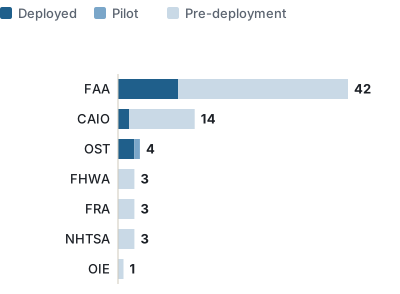
The file names the office behind each use case in a bureau column, and some DOT rows name several offices. Taking the first office named on each row, with the FAA's offices grouped, the Federal Aviation Administration accounts for 42 of the 70, with 11 deployed.[1] The department's Chief AI Officer organisation, "CAIO" in the file, leads 14, most of them governance teams and working groups rather than systems.[1] The Office of the Secretary has 4, and the Federal Highway Administration, the Federal Railroad Administration and the National Highway Traffic Safety Administration have 3 each, all before deployment.[1]
The bureau column names none of FTA, FMCSA, PHMSA or MARAD: the transit, motor carrier, pipeline and maritime administrations list no use case of their own in the 2025 file.[1]
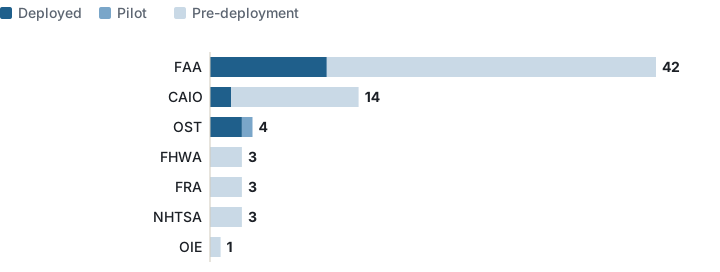
| Lead organisation (as the file names it) | Use cases | Deployed | Pilot | Pre-deployment |
|---|---|---|---|---|
| FAA | 42 | 11 | 0 | 31 |
| CAIO | 14 | 2 | 0 | 12 |
| OST | 4 | 3 | 1 | 0 |
| FHWA | 3 | 0 | 0 | 3 |
| FRA | 3 | 0 | 0 | 3 |
| NHTSA | 3 | 0 | 0 | 3 |
| OIE | 1 | 0 | 0 | 1 |
Data: dot-use-cases-by-bureau-string-2025.csv (the bureau column exactly as given)
What the uses are
By topic, 48 of the 70 are filed under transportation and 22 under administrative functions.[1] By the kind of AI the agency chose, 43 are "Other", 15 generative AI, 5 classical machine learning, 4 agentic AI and 3 natural language processing.[1]
The use case names show where the work is. In air traffic and technical operations the FAA lists "Technical Operations Predictive Maintenance" (FAA AJO, pre-deployment), "Pilot-Controller Voice to Text Transcription" (FAA AJO, pre-deployment) and "Detection of Unmanned Aircraft Systems (UAS) Encounter" (FAA AJO, pre-deployment); the oldest operational date in the DOT rows belongs to "Offshore Precipitation Capability (OPC)" (FAA ANG, pre-deployment), 1 December 2013, and the oldest among the deployed rows to "Surface Safety Metric (SSM)" (FAA AJO, deployed), 1 October 2018.[1] On the rails the FRA lists "Automatic Track Change Detection Demonstration and Analysis" (FRA, pre-deployment) and "Predictive Analytics Using Autonomous Track Geometry Measurement System (ATGMS) Data" (FRA, pre-deployment).[1] NHTSA's three are "Head Kinematics Prediction" (NHTSA, pre-deployment), "Crash Parameter Prediction" (NHTSA, pre-deployment) and an interim guidance on generative AI.[1] The FHWA lists "Geolocating and Identifying Vehicle Hard Brake, Acceleration and Seat Belt Usage with CV Data" (FHWA, pre-deployment).[1]
The deployed rows are mostly office tools: 2 document searches, "Financial Policy LLM Document Search" (FAA AFN, deployed) and "Spectrum Assignment & Engineering Team LLM Document Search" (FAA AJO, deployed), a "Community Engagement Chat Bot" (FAA APL, deployed), and a "Public Comment Analyzer (PCA)" (OST, deployed) labelled agentic AI; the search over FAA orders is still before deployment.[1] Only 3 of the 70 rows name a vendor: Google (2 rows) and GSA (1 row), all at the Office of the Secretary.[1]
The earlier version of this site ran explainers on self-driving cars, traffic management, predictive maintenance and AI in delivery. The federal record covers those subjects only where an agency builds a tool or regulates one.
Data: dot-use-cases-by-topic-2025.csv · dot-use-cases-by-classification-2025.csv
Automated vehicles on the road
NHTSA's page on automated vehicles describes six levels of driving automation, from Level 0, where the driver must steer, brake and accelerate, to Level 5, where the system "can operate the vehicle universally".[7] It states that "There is no vehicle currently available for sale that is fully automated or 'self-driving'", that Level 4 and Level 5 are not available on today's vehicles for consumer purchase, and that states permit limited testing which NHTSA monitors through its Standing General Order.[7] The same page gives 39,254 people killed in motor vehicle crashes in 2024, and says that in 2025 the department unveiled a new automated vehicle framework that included an amended Standing General Order and domestic exemptions.[7]
The crash reports
The Standing General Order, first issued in 2021 and amended in 2021, 2023 and 2025, requires named manufacturers and operators to report crashes in which an automated driving system (ADS) or a Level 2 driver assistance system (ADAS) was in use within 30 seconds of the crash.[5] The third amendment was issued on 24 April 2025 and took effect on 16 June 2025; it asks for a report within five days for the most severe crashes and a monthly report for the rest.[5] The criteria are stricter for ADS than for ADAS, and only the named entities have to report.[5]
NHTSA publishes the reports as CSV files, updated monthly, and the current files cover reports received from 16 June 2025 to 15 September 2026.[5] Counting one report per NHTSA report number, and taking the latest version of each, the files hold 1,551 ADS reports and 2,427 Level 2 ADAS reports.[6] (The files have 1,595 and 2,574 rows, because an updated report is a new row under the same number.[6])
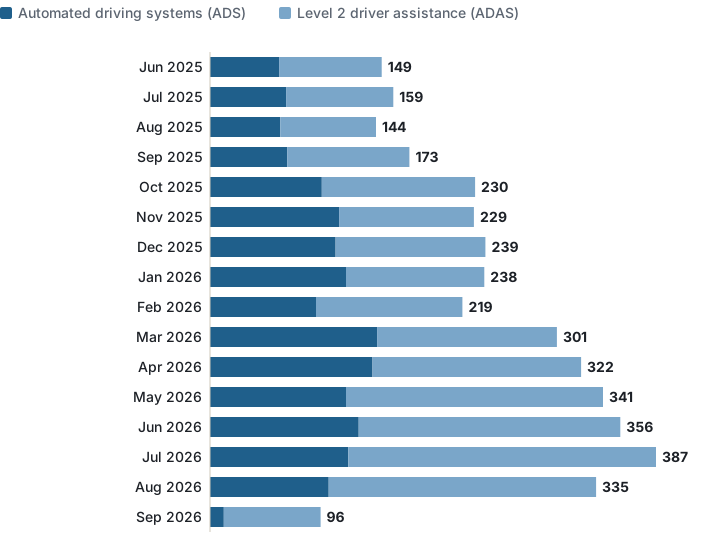
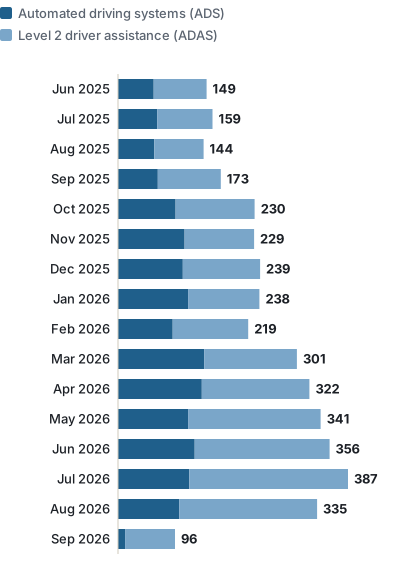
By the month of the crash, reports rose from 149 in June 2025 to 387 in July 2026, with the Level 2 ADAS reports making most of the rise.[6] 59 reports in the files concern crashes before June 2025.[6] The highest injury severity alleged is "Unknown" on 2,193 of the ADAS reports; 27 ADAS reports and 2 ADS reports allege a fatality.[6]
NHTSA's own cautions apply: the reports are not normalised for vehicles or miles driven, so they do not compare one company with another; an initial report may be incomplete; and several reports can refer to the same crash.[5] A count of reports is not a crash rate.
Data: nhtsa-sgo-reports-by-severity.csv · nhtsa-sgo-files-2026-10-29.csv
AI in aviation safety
The FAA's Roadmap for Artificial Intelligence Safety Assurance, Version I, has its foreword signed on 23 July 2024 by the Associate Administrator for Aviation Safety.[4] Its stated purpose is "a path to assuring the safety of AI in aircraft" and in related systems for inflight operations, and it extends that to using AI for safety.[4] It follows a 2022 recommendation of the FAA's research advisory committee and meetings with industry through 2023 and 2024.[4]
The roadmap sets out principles: work within the existing aviation safety ecosystem; focus on the safety of AI and on AI for safety; avoid personification, treating AI "as a tool, not a human"; distinguish learned (static) AI from learning (dynamic) AI; take an incremental approach; use the safety continuum, starting with lower-risk applications; and adopt industry consensus standards.[4] It names five areas of next steps: collaboration, FAA workforce readiness, assuring the safety of AI, using AI for safety, and aviation safety research.[4] Its example of machine learning already in service is the collision avoidance standard ACAS X, whose risk models were developed through machine learning in place of the scenario-based design of earlier TCAS versions.[4]
DOT's strategy
DOT's AI page, last updated on 15 October 2026, now speaks of "super intelligence" and names two areas of work: safe integration into the transportation system, listing automated driving systems, unmanned aircraft systems, conventional aircraft systems and traffic management, and adopting the tools in the department's own operations, research and public-facing services.[8] It links the department's AI policy order, its three-part AI strategy and its compliance plan for OMB Memorandum M-25-21.[8]
Part I of the strategy, for fiscal years 2026 and 2027, aligns AI use cases to four draft strategic goals, "Safety, Infrastructure, Innovation, and Efficiency", and describes illustrative uses under each, from reading voluntary safety reports to generating bridge design options.[9] It gives no count of use cases by operating administration; the inventory above is the only public count found for this page.[9][1]
Counting caveats
- The inventory is self-reported, one row per use case, and a long list says what an agency chose to report, not how much it relies on AI.[2]
- The lead-organisation grouping on this page is this site's rule: the first office named on each row, with FAA offices combined. The file's own bureau strings are published beside it.[1]
- The inventory leaves out AI in national security systems, AI used for research, Department of War use cases (the Department of Defense, under the name OMB's file uses) and common off-the-shelf tools, which go in a separate file.[2]
- The crash report files change monthly and the September 2026 month is partial; the counts here are of the files read on 29 October 2026.[6]
See also: AI in the public sector, Generative AI in government, Data science in government, and the data story 3,611 uses of AI on the federal list.
Sources
- Office of Management and Budget, 2025 Federal Agency AI Use Case Inventory, file of individually reported use cases (3,611 rows; the repository says "as of April 13, 2026"), counted by this site: 2025_individually_reported_AI_use_cases.csv. Read 28 October 2026.
- Office of Management and Budget, 2025 Federal Agency AI Use Case Inventory repository, README (summary, submission schedule and exclusion criteria). Read 28 October 2026.
- Office of Management and Budget, 2025 inventory data dictionary. Read 28 October 2026.
- Federal Aviation Administration, Roadmap for Artificial Intelligence Safety Assurance, Version I (PDF, 31 pages; foreword signed 23 July 2024). Read 29 October 2026.
- National Highway Traffic Safety Administration, Standing General Order on Crash Reporting (page on the order, its amendments and the data files). Read 29 October 2026.
- National Highway Traffic Safety Administration, Standing General Order 2021-01 incident report files, ADS and Level 2 ADAS (CSV, reports received 16 June 2025 to 15 September 2026), with the data element definitions; counted by this site. Read 29 October 2026.
- National Highway Traffic Safety Administration, Automated Vehicles for Safety. Read 29 October 2026.
- U.S. Department of Transportation, U.S. DOT Super Intelligence Activities (page last updated 15 October 2026). Read 29 October 2026.
- U.S. Department of Transportation, AI Strategy FY 2026-2027, Part I: AI Use Case Strategic Alignment (PDF; its page was last updated 3 October 2025). Read 29 October 2026.
How this page was counted: rows of OMB's file whose agency column is "DOT", by the agency_bureau, development_stage, topic_area, classification, is_high_impact and vendor_name columns, read on 28 October 2026; and NHTSA's two Standing General Order files, one count per distinct Report ID taking its latest version, by the Incident Date and Highest Injury Severity Alleged columns, read on 29 October 2026. The CSV files beside this page carry the counts, the source addresses, the read dates and a README with every rule.