Guide · Intellectual property
AI and intellectual property
What the Patent and Trademark Office says it uses AI for, counted from the public inventory, and what the two agencies that administer patents and copyrights have said about inventions and works made with AI: the USPTO's inventorship guidance of 2024 and its 2025 replacement, and the Copyright Office's report on copyrightability.
The public record
Federal agencies list their AI use cases each year and OMB compiles the lists into one public file of 3,611 rows.[2][1] The United States Patent and Trademark Office appears in it as a bureau of the Department of Commerce, "USPTO", with 15 use cases.[1] The Copyright Office, which the report cited below describes as "housed in the Library of Congress", does not appear in the file as an agency or a bureau.[6][1]
Every Department of Commerce row in OMB's file, the USPTO's included, has an empty stage, topic, classification and high-impact cell: of the department's 223 rows, 0 carry a stage.[1] What the USPTO rows do carry is a name and, for all 15 of them, a statement of the problem the AI is meant to solve; the department's other bureaus give that statement in 10 rows.[1]
What the USPTO lists
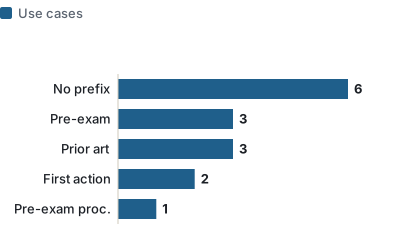
9 of the 15 names are written as stages of patent examination.[1] Of the 15, 3 begin "Pre-Exam Application": one auto-assigns Cooperative Patent Classification symbols, of which the problem statement says there are "currently over 250,000"; one checks the document codes applicants assign; one routes cases to examiner groups by subject.[1] Another 3 begin "Prior Art Search": a similarity search that finds documents like the one an examiner is reading, an image search, and a pilot that gives applicants an early "top ten list" of potential prior-art issues.[1] And 2 begin "First Office Action Creation": a claim comparison for double patenting and a report of potential issues under sections 101 and 112 of the patent statute.[1]
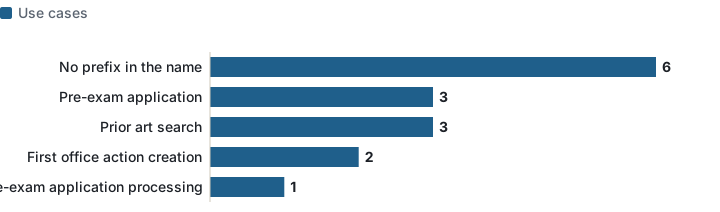
The trademark side has 3 rows: a word and image search tool for clearance searches before filing, a Trademark Center automation that suggests design search codes and international classes from a mark drawing, and the public virtual assistant that answers patent and trademark questions.[1] The other rows are a patent fraud detection tool, a generative AI platform for staff, a coding assistant and a service-desk automation.[1]
| Prefix | Use case, as named in the file (punctuation removed) | Keywords in name or problem statement |
|---|---|---|
| No prefix | Assisted software development | none |
| No prefix | Call Center Automations (Internal) | none |
| No prefix | GenAI platform and applications for general productivity | none |
| No prefix | Patent Fraud Detection & Mitigation | patent |
| No prefix | TM Word and Image Search Tool (TWIST) | none |
| No prefix | Virtual Assistant (Public) | patent; trademark |
| First Office Action Creation | First Office Action Creation: Claim Comparision for Double Patenting | patent |
| First Office Action Creation | First Office Action Creation: Examination Analysis Determination/Analysis of Informalities (35 USC 101 and 112) | patent |
| Pre-Exam Application | Pre-Exam Application: CPC Classification | patent |
| Pre-Exam Application | Pre-Exam Application: Front End Document Code Quality Control | patent |
| Pre-Exam Application | Pre-Exam Application: Skill Group Matching | patent |
| Pre-Exam Application Processing | Pre-Exam Application Processing: Trademark Center (TM Center) AI Automation | trademark |
| Prior Art Search | Prior Art Search: AI Retrieval for Patent Search (PSAI) (Similarity Search) | patent |
| Prior Art Search | Prior Art Search: Automated Search AI Pilot (ASAP Report) | none |
| Prior Art Search | Prior Art Search: Patent Image Search | patent |
Data: ip-uspto-rows-2025.csv (one name is shown without the exclamation mark the file gives it)
Patent, trademark, copyright
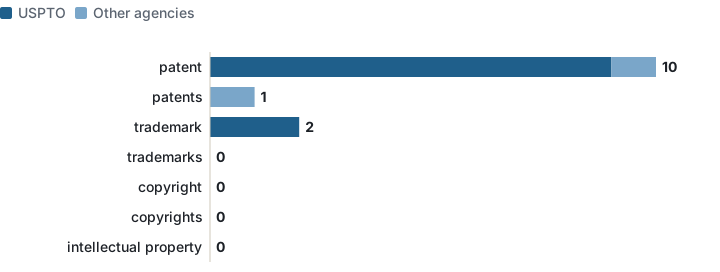
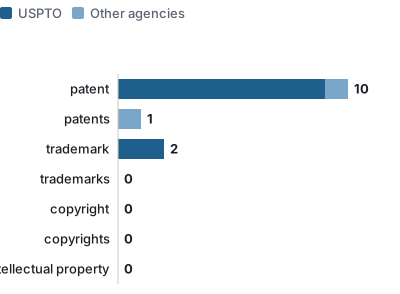
A whole-word, case-insensitive search of every use case's name and problem statement for seven words finds 12 rows, 10 of them the USPTO's.[1] "Patent" matches 10 and "trademark" 2; "trademarks", "copyright", "copyrights" and "intellectual property" match no row at all.[1] The 2 matches outside the USPTO are the Bureau of Land Management's General Land Office records modernisation, where "patents" means land patents, and a National Science Foundation data project whose problem statement mentions patents among research outputs.[1] No agency describes a use case in terms of copyright.[1]
Who is the inventor
On 13 February 2024 the USPTO published inventorship guidance for AI-assisted inventions, issued under the executive order of 30 October 2023 on AI.[4] It said that AI-assisted inventions "are not categorically unpatentable", that the inventorship analysis "should focus on human contributions", and that a patent may be sought where a natural person "provided a significant contribution to the invention", judged by the factors of a 1998 Federal Circuit case, Pannu v. Iolab.[4][5] It rested on Thaler v. Vidal, in which the Federal Circuit held that only a natural person can be an inventor, took effect the day it was published for all applications filed before or after, and invited comments until 13 May 2024.[4]
On 28 November 2025 the USPTO rescinded that guidance "in its entirety" and replaced it.[5] The revised guidance says the approach of applying the Pannu factors to AI-assisted inventions "is withdrawn", because those factors apply only when several natural persons may be joint inventors; AI systems "are not persons" and cannot be joint inventors, so with one human inventor there is no joint-inventorship question.[5] The standard is the same for every invention: there is "no separate or modified standard for AI-assisted inventions", the inquiry turns on conception, "the touchstone of inventorship", and an application that lists an AI system as an inventor should be rejected.[5] The use of AI tools "does not change the joint inventorship analysis" among human contributors, and the guidance applies to design and plant patents as well as utility patents.[5]
Who is the author
The Copyright Office is issuing its report on copyright and AI in parts, following a notice of inquiry of August 2023; the first part, published in 2024, addresses digital replicas, the second, of January 2025, addresses the copyrightability of outputs made with generative AI, and a later part is to turn to the training of AI models on copyrighted works.[6] Part 2 reaches eight conclusions.[6] Questions of copyrightability and AI "can be resolved pursuant to existing law"; using AI to assist rather than replace human creativity does not affect protection; copyright protects the human author's original expression even in a work that also includes AI-generated material; it "does not extend to purely AI-generated material", or to material with insufficient human control over the expressive elements; sufficiency of human contribution is decided case by case; on current technology, "prompts do not alone provide sufficient control"; human authors keep copyright in their own work perceptible in AI outputs and in the creative selection, arrangement or modification of outputs; and "the case has not been made" for new or sui generis protection of AI-generated content.[6] The Office says it will update its registration guidance and its Compendium of practices, and will revisit the conclusions as technology and law develop.[6]
The earlier version of this site ran two posts on AI and the future of intellectual property and on infringement in NFT marketplaces. They are retired; the record above is what the two offices have published.
Counting caveats
- The USPTO's rows carry no stage, so this page cannot say how many of its 15 use cases are deployed; the names and problem statements are what the file gives.[1]
- The keyword rule matches words, not subjects: "patents" in the Bureau of Land Management's row means land patents.[1]
- The Copyright Office, housed in the Library of Congress, is not among the agencies in OMB's file, so this page cites its policy report, not an inventory of its own AI use.[6][1]
- The February 2024 guidance is cited for what it said when in force; it was rescinded on 28 November 2025 and the revised guidance governs.[4][5]
- Part 3 of the Copyright Office report, on AI training, was not consulted; the record used is Part 2.
See also: Generative AI in government, AI in the public sector, AI in government IT and cybersecurity, AI explained: the terms the federal inventory uses, and the data story 3,611 uses of AI on the federal list.
Sources
- Office of Management and Budget, 2025 Federal Agency AI Use Case Inventory, file of individually reported use cases (3,611 rows; the repository says "as of April 13, 2026"), counted by this site: 2025_individually_reported_AI_use_cases.csv. Read 28 October 2026.
- Office of Management and Budget, 2025 Federal Agency AI Use Case Inventory repository, README (summary, submission schedule and exclusion criteria). Read 28 October 2026.
- Office of Management and Budget, 2025 inventory data dictionary. Read 28 October 2026.
- U.S. Patent and Trademark Office, Inventorship Guidance for AI-Assisted Inventions, 89 FR 10043, Federal Register, 13 February 2024 (govinfo). Read 29 October 2026.
- U.S. Patent and Trademark Office, Revised Inventorship Guidance for AI-Assisted Inventions, 90 FR 54636, Federal Register, 28 November 2025 (govinfo). Read 29 October 2026.
- U.S. Copyright Office, Copyright and Artificial Intelligence, Part 2: Copyrightability, a report of the Register of Copyrights, January 2025. Read 29 October 2026.
How this page was counted: one row per use case in OMB's file, read on 28 October 2026. Rule A: a use case is the USPTO's when its agency_bureau column, surrounding spaces removed, is exactly "USPTO". Rule B: a whole-word, case-insensitive match in use_case_name or problem_solved of patent, patents, trademark, trademarks, copyright, copyrights or intellectual property; a row counts once. Rule C: a USPTO row's prefix is the text before the first colon in its name, or "no prefix". Empty cells are counted as "no stage given" or "no answer". The Federal Register notices and the Copyright Office report were read on 29 October 2026. README.txt beside the CSV files repeats the rules.