Guide · Economy
AI and the economy
What the federal economic-statistics bureaus and the economic agencies say they use AI for, counted from the public inventory, and what a search of that inventory for the words of economics turns up.
The public record
Federal agencies list their AI use cases each year and OMB compiles the lists into one public file of 3,611 rows.[3][1] This guide reads that file three ways: by the bureaus that produce the economic statistics (the Bureau of Labor Statistics, the Bureau of Economic Analysis and the Census Bureau), by the economic agencies (the Treasury, the Small Business Administration, the Federal Reserve Board and Commerce's International Trade Administration), and by a search of every row for nine words of economics.[1] The agencies are named as the file names them.[2]
Which agencies, how many
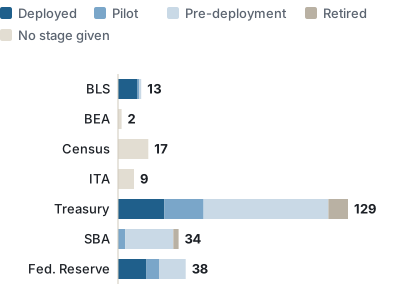
The seven groups list 242 use cases between them. The Treasury lists 129, of which 26 are deployed and 70 are before deployment; the Federal Reserve Board 38, with 16 deployed; the Small Business Administration 34, none deployed and 4 in pilot.[1] The Bureau of Labor Statistics lists 13, with 11 deployed; the Census Bureau 17, the International Trade Administration 9 and the Bureau of Economic Analysis 2.[1] Every Department of Commerce row, and so every Census, BEA and ITA row, has an empty stage, topic, classification and high-impact cell in OMB's file, so for those three bureaus the count is all this guide can give.[1]
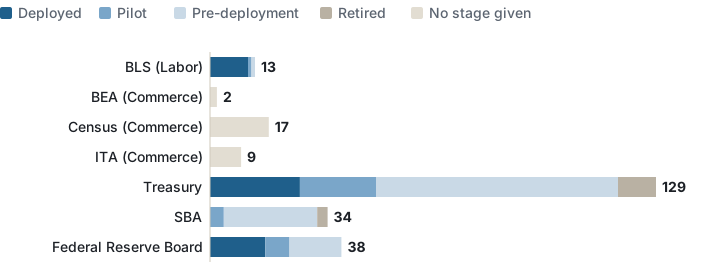
| Group | Deployed | Pilot | Pre-deployment | Retired | No stage given | Total | High-impact |
|---|---|---|---|---|---|---|---|
| BLS (Department of Labor) | 11 | 1 | 1 | 0 | 0 | 13 | 0 |
| BEA (Department of Commerce) | 0 | 0 | 0 | 0 | 2 | 2 | 0 |
| Census (Department of Commerce) | 0 | 0 | 0 | 0 | 17 | 17 | 0 |
| ITA (Department of Commerce) | 0 | 0 | 0 | 0 | 9 | 9 | 0 |
| TREAS (Department of the Treasury) | 26 | 22 | 70 | 11 | 0 | 129 | 4 |
| SBA (Small Business Administration) | 0 | 4 | 27 | 3 | 0 | 34 | 0 |
| FRB (Federal Reserve Board) | 16 | 7 | 15 | 0 | 0 | 38 | 0 |
| All 3,611 use cases | 1040 | 440 | 1479 | 314 | 338 | 3,611 | 445 |
Only the Treasury marks any of these use cases high-impact: 4, OMB's term for AI whose output is a principal basis for a decision with a legal, material, binding or significant effect.[1][2]
The statistical bureaus
The Bureau of Labor Statistics files all 13 of its use cases under one topic of its own wording, applied mathematical sciences, and classifies every one as classical machine learning.[1] Of these, 5 are autocoders, "Computer-Assisted Coding: SOII Autocoder", "Computer-Assisted Review: ORS Autocoder", "Expenditure Classification Autocoder", "OEWS Occupation Autocoder", "QCEW NAICS Autocoder", which assign survey write-ins to statistical codes; the other names speak of record matching, price tolerance prediction, item code estimation, imputation, sample refinement, product classification and comment scoring.[1] This is AI inside statistical production rather than AI as a subject of the statistics.
The Census Bureau's 17 rows include "Real Time Classification for the Economic Census", "Race and Ethnicity Autocoding", "Linkage and Matching Program (LaMP)" and a natural-language search for data.census.gov; the Bureau of Economic Analysis lists a code assistant and meeting transcription.[1] The Census Bureau described the method behind autocoding in a 2015 working paper on the American Community Survey: in 2010 the survey had a workload of 2.48 million manually coded industry and occupation records a year, an autocoder was introduced in 2012, and in that year 887,750 of 3,016,617 records were autocoded, a rate of 29.4 percent, with a logistic regression model scoring each candidate code and records below a cutoff going to clerical coders.[6]
| Bureau | Use case, as named in the file (punctuation removed) | Stage | Topic | Type of AI |
|---|---|---|---|---|
| BEA | GitHub Copilot for Code Modernization | No stage given | No topic given | No classification given |
| BEA | Meeting Transcription Summarization | No stage given | No topic given | No classification given |
| BLS | CE Interview Imputations | Deployed | Other, applied mathematical sciences (as the file gives it) | Classical ML |
| BLS | CE Interview Item Code Estimation | Deployed | Other, applied mathematical sciences (as the file gives it) | Classical ML |
| BLS | CFOI Record Matching | Deployed | Other, applied mathematical sciences (as the file gives it) | Classical ML |
| BLS | Comment Actionability Likelihood Score | Deployed | Other, applied mathematical sciences (as the file gives it) | Classical ML |
| BLS | Computer-Assisted Coding: SOII Autocoder | Deployed | Other, applied mathematical sciences (as the file gives it) | Classical ML |
| BLS | Computer-Assisted Review: ORS Autocoder | Pre-deployment | Other, applied mathematical sciences (as the file gives it) | Classical ML |
| BLS | CPS OTC Prediction | Deployed | Other, applied mathematical sciences (as the file gives it) | Classical ML |
| BLS | Expenditure Classification Autocoder | Deployed | Other, applied mathematical sciences (as the file gives it) | Classical ML |
| BLS | OEWS Occupation Autocoder | Deployed | Other, applied mathematical sciences (as the file gives it) | Classical ML |
| BLS | PPI Price Tolerance Prediction | Deployed | Other, applied mathematical sciences (as the file gives it) | Classical ML |
| BLS | QCEW NAICS Autocoder | Pilot | Other, applied mathematical sciences (as the file gives it) | Classical ML |
| BLS | Sample Refinement: Frame API | Deployed | Other, applied mathematical sciences (as the file gives it) | Classical ML |
| BLS | Scanner Data Product Classification | Deployed | Other, applied mathematical sciences (as the file gives it) | Classical ML |
| Census | ACES CAPEX (structures, equipment, other) Machine Learning | No stage given | No topic given | No classification given |
| Census | Automated Change Detection | No stage given | No topic given | No classification given |
| Census | Automating Multilingual Census Data Processing: An AI and Transformer-Based Pipeline for Efficient Language Detection and Translation for Short-Text | No stage given | No topic given | No classification given |
| Census | Census API GPT | No stage given | No topic given | No classification given |
| Census | Census Bureau Demographic Frame Person-Place Model | No stage given | No topic given | No classification given |
| Census | Census Research Exploration and Analysis Tool (CREAT) | No stage given | No topic given | No classification given |
| Census | Current Population Survey (CPS) Name Screening Tool | No stage given | No topic given | No classification given |
| Census | Dr NAICS LLM | No stage given | No topic given | No classification given |
| Census | DSD Python Code Translation | No stage given | No topic given | No classification given |
| Census | FAQ for SMaRT | No stage given | No topic given | No classification given |
| Census | Information extraction for web scraped data for Group Quarters frame enhancement | No stage given | No topic given | No classification given |
| Census | Linkage and Matching Program (LaMP) | No stage given | No topic given | No classification given |
| Census | Natural Language Search for data.census.gov | No stage given | No topic given | No classification given |
| Census | Race and Ethnicity Autocoding | No stage given | No topic given | No classification given |
| Census | Real Time Classification for the Economic Census | No stage given | No topic given | No classification given |
| Census | School staff information extraction from web page text | No stage given | No topic given | No classification given |
| Census | Statistical package syntax development and debugging | No stage given | No topic given | No classification given |
Data: economy-statistics-bureau-rows-2025.csv (one Census tool's name is shown without the stop the file writes after "Dr")
Treasury
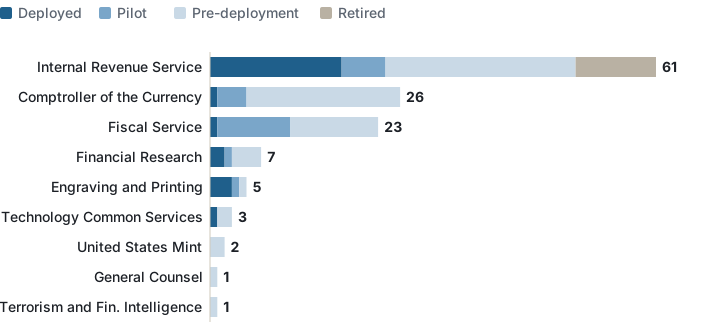
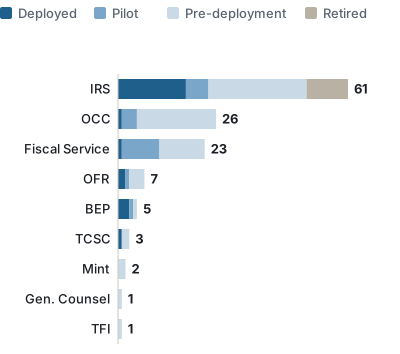
The Internal Revenue Service lists 61 of the Treasury's 129 use cases, with 18 deployed, 26 before deployment and 11 retired.[1] The Office of the Comptroller of the Currency lists 26, 21 of them before deployment, and the Bureau of the Fiscal Service 23, with 10 pilots.[1] The IRS's deployed rows include "Taxpayer Services Chatbot", "Identity Verification", "Form 990N Machine Learning Model", "Machine Translation" and two text-clustering tools for tax disclosures and the employee retention credit; the Fiscal Service's one deployed row is "FORMS AI".[1]
The Treasury's own AI page, which now calls the subject super intelligence, links to an inventory of January 2026 that carries the same 129 use cases with the same bureaus and stages as OMB's file, beside the department's AI strategy and compliance plan.[4][5][1]
Data: treasury-by-bureau-2025.csv
The words of economics
A whole-word, case-insensitive search of every use case's name and problem statement for nine words finds 42 of the 3,611 rows.[1] 17 match "economic" and 13 match "employment" and 13 match "trade"; "economy", "labor market", "inflation", "GDP", "tariff" and "procurement spend" match none.[1] The largest share, 11, is the Department of Homeland Security's, 10 of them Customs and Border Protection rows, among them models for cargo, trade entities and illicit trade; 7 are the Justice Department's, 6 of them Antitrust Division rows named for statistical software or a consulting contract; 6 are rows of one Education Department office whose problem statements mention employment.[1] The Federal Reserve Board's two matches are "Economic Trend Modeling" and "Supply Chain Estimations".[1]
The inventory's own topic list has no economics entry, and the Federal Reserve Board filed 34 of its 38 rows under a topic of its own wording, economic and financial, 21 of them from its Division of Supervision and Regulation.[2][1]
| Agency | Use cases matched |
|---|---|
| DHS | 11 |
| DOJ | 7 |
| ED | 6 |
| DOL | 4 |
| VA | 3 |
| DOI | 2 |
| FRB | 2 |
| NCUA | 2 |
| DOC | 1 |
| FDIC | 1 |
| HHS | 1 |
| TVA | 1 |
| USDA | 1 |
Data: economy-keyword-rows-2025.csv · economy-keyword-counts-2025.csv · economy-other-topic-by-bureau-2025.csv
The earlier version of this site ran nine posts on AI in economics and business, predictive analytics and market trends. They are retired; what a reader can check is the list above and the documents behind it.
Counting caveats
- The Department of Commerce's 28 rows counted here, like all of its rows in OMB's file, carry no stage, topic, classification or high-impact answer, so they cannot be compared with the other groups on those columns.[1]
- The keyword rule matches words, not subjects: "trade" matches trade enforcement and a chat tool, "employment" matches vocational services, and "economic" matches an antitrust division's software.[1]
- The Bureau of Labor Statistics and the Federal Reserve Board wrote topic values of their own instead of choosing from OMB's list; the file keeps them as written.[2][1]
- The inventory excludes AI used for basic or applied research unless it is meant for agency use, and the earlier site's subject, AI in private businesses, is outside it altogether.[3]
- A record of the Bureau of Labor Statistics' own account of how it treats AI in its employment projections was not consulted; the record used for BLS is OMB's file.
See also: AI in financial management, Data science in government, AI in the public sector, Generative AI in government, and the data story 3,611 uses of AI on the federal list.
Sources
- Office of Management and Budget, 2025 Federal Agency AI Use Case Inventory, file of individually reported use cases (3,611 rows; the repository says "as of April 13, 2026"), counted by this site: 2025_individually_reported_AI_use_cases.csv. Read 28 October 2026.
- Office of Management and Budget, 2025 inventory data dictionary. Read 28 October 2026.
- Office of Management and Budget, 2025 Federal Agency AI Use Case Inventory repository, README (summary, submission schedule and exclusion criteria). Read 28 October 2026.
- U.S. Department of the Treasury, Treasury and Super Intelligence (the department's AI page, with its use case inventory of January 2026). Read 29 October 2026.
- U.S. Department of the Treasury, Treasury AI Use Case Inventory, January 2026, CSV file, counted by this site. Read 29 October 2026.
- U.S. Census Bureau, Using an Autocoder to Code Industry and Occupation in the American Community Survey, working paper, 2015. Read 29 October 2026.
How this page was counted: one row per use case in OMB's file, read on 28 October 2026. Rule A, the statistical bureaus: the agency_bureau column, surrounding spaces removed, is exactly "BLS", "BEA" or "Census". Rule B, the economic agencies: the agency column is exactly "TREAS", "SBA" or "FRB", and the bureau column is exactly "ITA". Rule C, the keyword search: a whole-word, case-insensitive match in use_case_name or problem_solved of economic, economy, employment, labor market, inflation, GDP, trade, tariff or procurement spend; a row counts once. Rule D: the topic value "Other, Economic and Financial" is counted as the file writes it. Stages, topics, classifications and high-impact answers are those columns as given, with an empty cell counted as "no stage given" or "no topic given". Treasury's own CSV was read on 29 October 2026 and its rows, bureaus and stages counted the same way. README.txt beside the CSV files repeats the rules.