Guide · Financial management
AI in financial management
Where federal agencies say they use AI for payments, fraud, audit, grants, invoices and accounting: the rows of the public inventory filed under procurement and financial management or naming those words, with the Treasury's own account of machine learning against improper payments.
The rule and the count
OMB's inventory of federal AI use cases has a topic for this subject, which the data dictionary names "Procurement and Financial Management" and the file shortens to "Procurement and Finance Mgmt".[2] This guide takes every row filed under it, and every row whose name or problem statement contains, as a whole word, one of fourteen words: payment, payments, fraud, audit, audits, auditing, accounting, invoice, invoices, improper payment, improper payments, grants management, grant management, financial management.[1] That gives 155 of the 3,611 use cases: 90 are in the topic, 78 match a keyword, and 13 do both.[1] Of the 155, 58 are deployed, 15 are pilots, 76 are before deployment and 2 retired, so 37% are deployed against 29% for the whole file.[1]
| Group | Deployed | Pilot | Pre-deployment | Retired | No stage given | Total | High-impact |
|---|---|---|---|---|---|---|---|
| Rows matching the rule | 58 | 15 | 76 | 2 | 4 | 155 | 21 |
| All 3,611 use cases | 1040 | 440 | 1479 | 314 | 338 | 3,611 | 445 |
Data: finance-by-stage-2025.csv · finance-rows-2025.csv (every matching row)
Which agencies
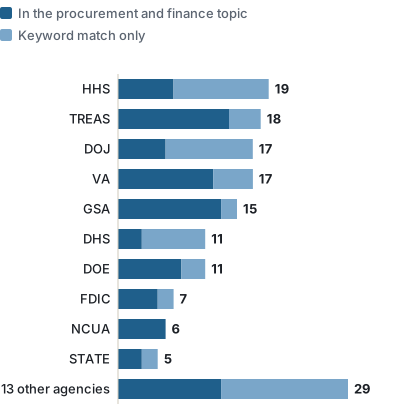
Matching rows come from 23 agencies. Health and Human Services has the largest share with 19, 12 of them by keyword alone; the Treasury has 18, 14 of them in the topic; Justice and Veterans Affairs 17 each; the General Services Administration 15, 13 in the topic; Homeland Security and Energy 11 each.[1] The National Credit Union Administration's 6 rows are all in the topic and 5 of them are high-impact.[1]
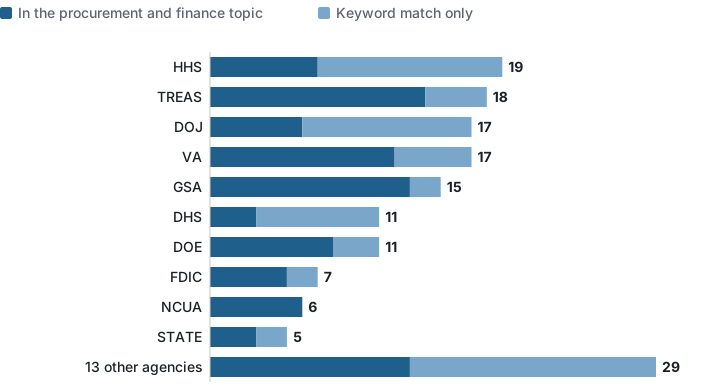
| Agency | In the topic | Keyword only | Deployed | Pilot | Pre-deployment | Total | High-impact |
|---|---|---|---|---|---|---|---|
| Department of Health and Human Services | 7 | 12 | 9 | 2 | 8 | 19 | 0 |
| Department of the Treasury | 14 | 4 | 7 | 4 | 7 | 18 | 1 |
| Department of Justice | 6 | 11 | 5 | 2 | 10 | 17 | 4 |
| Department of Veterans Affairs | 12 | 5 | 4 | 2 | 11 | 17 | 6 |
| General Services Administration | 13 | 2 | 6 | 1 | 8 | 15 | 0 |
| Department of Homeland Security | 3 | 8 | 4 | 1 | 6 | 11 | 4 |
| Department of Energy | 8 | 3 | 3 | 0 | 7 | 11 | 0 |
| Federal Deposit Insurance Corporation | 5 | 2 | 2 | 0 | 5 | 7 | 0 |
| National Credit Union Administration | 6 | 0 | 6 | 0 | 0 | 6 | 5 |
| Department of State | 3 | 2 | 3 | 0 | 2 | 5 | 0 |
| Department of Agriculture | 3 | 2 | 2 | 2 | 1 | 5 | 0 |
| Department of the Interior | 2 | 2 | 1 | 1 | 2 | 4 | 0 |
| Pension Benefit Guaranty Corporation | 4 | 0 | 1 | 0 | 3 | 4 | 0 |
| National Aeronautics and Space Administration | 2 | 1 | 0 | 0 | 3 | 3 | 0 |
| Department of Commerce | 0 | 2 | 0 | 0 | 0 | 2 | 0 |
| Department of Education | 0 | 2 | 0 | 0 | 0 | 2 | 0 |
| Small Business Administration | 0 | 2 | 0 | 0 | 2 | 2 | 0 |
| Social Security Administration | 0 | 2 | 2 | 0 | 0 | 2 | 1 |
| Election Assistance Commission | 0 | 1 | 1 | 0 | 0 | 1 | 0 |
| Federal Energy Regulatory Commission | 0 | 1 | 0 | 0 | 1 | 1 | 0 |
| Federal Housing Finance Agency | 1 | 0 | 1 | 0 | 0 | 1 | 0 |
| Department of Housing and Urban Development | 1 | 0 | 1 | 0 | 0 | 1 | 0 |
| Securities and Exchange Commission | 0 | 1 | 0 | 0 | 0 | 1 | 0 |
Treasury, GSA and SSA
The Treasury's 18 rows come from 5 bureaus. The Internal Revenue Service has 10, among them a deployed "DATA Act Bot for Procurement Data Matching", a deployed "AI Contract Document Toolbox" and a pilot "Vendor Risk Analytics"; the Bureau of the Fiscal Service has 2, both pilots, "AI-assisted Procurement POC", "USAspending Natural Language Search Initiative"; the Bureau of Engraving and Printing files its inventory and maintenance forecasts under the topic.[1] The General Services Administration, which reports no bureau, has 15 rows with 6 deployed, including "Solicitation Review Tool (SRT)", "Acquisition Analytics", "Strategic Atlas", and a pre-deployment "OCFO Chatbot".[1] The Social Security Administration's 2 matches come by keyword: a deployed, high-impact "Pre-Effectuation Review (PER) / Targeted Denial Review (TDR)" whose problem statement mentions payment, and a public question bot that also records fraud hotline calls.[1]
Offices of the chief financial officer appear by name in the bureau column of 6 rows across 4 agencies, of which 3 fall under the rule, including the Pension Benefit Guaranty Corporation's "Federal Accounting Statutes and Guidelines Alignment" and the Small Business Administration's "Audit Green Book Classification".[1]
| Agency | Bureau, as named in the file | Deployed | Pilot | Pre-deployment | Total | High-impact |
|---|---|---|---|---|---|---|
| GSA | (no bureau given) | 6 | 1 | 8 | 15 | 0 |
| SSA | Chief Information Officer, Analytics and Improvements | 1 | 0 | 0 | 1 | 1 |
| SSA | Chief Information Officer, Digital Customer Solutions | 1 | 0 | 0 | 1 | 0 |
| TREAS | Internal Revenue Service (IRS) | 4 | 2 | 4 | 10 | 1 |
| TREAS | Bureau of Engraving and Printing (BEP) | 3 | 0 | 1 | 4 | 0 |
| TREAS | Bureau of the Fiscal Service (BFS) | 0 | 2 | 0 | 2 | 0 |
| TREAS | Office of Financial Research (OFR) | 0 | 0 | 1 | 1 | 0 |
| TREAS | Technology Common Services Center (TCSC) | 0 | 0 | 1 | 1 | 0 |
Data: finance-treasury-gsa-ssa-by-bureau-2025.csv · finance-cfo-office-rows-2025.csv
Fraud, audit and payments
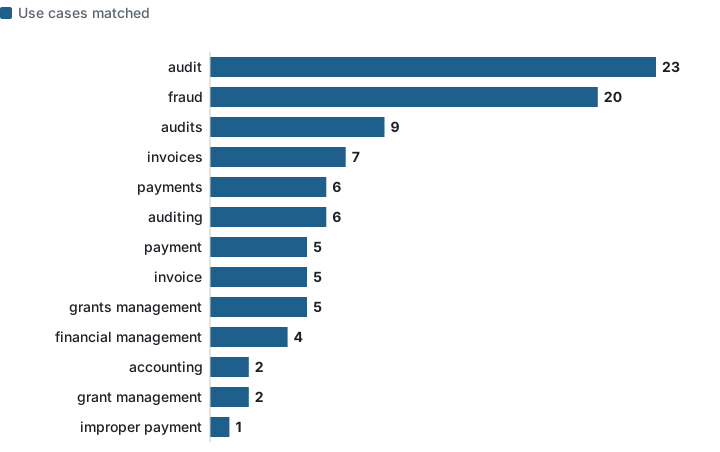
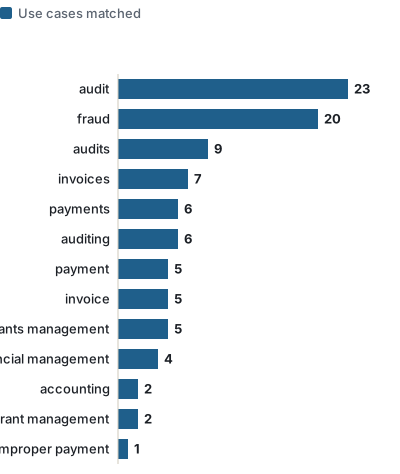
"Audit" in one of its three forms matches 33 rows; "fraud" matches 20, the payment words 11, and "improper payment" 1.[1] The fraud rows include Justice's "AI-driven Fraud Detection", "Claims Program Predictive Fraud Analytics" in the Civil Division and a deployed "Data & Analytics: Healthcare Fraud Detection" at the Drug Enforcement Administration, Veterans Affairs' deployed "Payment Redirect Fraud (PRF) Model", and GSA's Login.gov fraud detection.[1] "Grants management" and "grant management" together match 6 distinct rows and "accounting" 2.[1]
The high-impact rows
Of the 155 rows, 21 are marked high-impact, OMB's term for AI whose output is a principal basis for a decision with a legal, material, binding or significant effect.[1][2] Of those, 5 are the National Credit Union Administration's deployed supervisory models, "ADCo MBS/CMO Modeling", "CoStar CRE Modeling", "Moody’s Stress Test Modeling", "Risk Indicator Model", "Supervisory Stress Testing"; 6 are Veterans Affairs rows on claims, payments and pharmacy inventory; 4 are Justice's fraud and document tools.[1]
| Agency | Use case, as named in the file | Stage | In the topic | Keywords |
|---|---|---|---|---|
| DHS | AI Resume & ATS App | Pre-deployment | no | audit |
| DHS | Facial Recognition for Investigations of Transnational Criminal Organizations | Deployed | no | fraud |
| DHS | Text Analytics Data Science Sentence Similarity Model | Deployed | no | fraud |
| DHS | Criminal Investigations (OBIM) | Deployed | no | payment |
| DOJ | AI-driven Fraud Detection | Pre-deployment | no | fraud |
| DOJ | Claims Program Predictive Fraud Analytics | Pre-deployment | no | fraud |
| DOJ | Capture and Convert Structured Data from Scanned Case Documents to Support Advanced Analysis and Trend Forecasting | Pre-deployment | no | invoices |
| DOJ | Data & Analytics: Healthcare Fraud Detection | Deployed | no | fraud |
| NCUA | ADCo MBS/CMO Modeling | Deployed | yes | none |
| NCUA | CoStar CRE Modeling | Deployed | yes | none |
| NCUA | Moody’s Stress Test Modeling | Deployed | yes | none |
| NCUA | Risk Indicator Model | Deployed | yes | none |
| NCUA | Supervisory Stress Testing | Deployed | yes | none |
| SSA | Pre-Effectuation Review (PER) / Targeted Denial Review (TDR) Models | Deployed | no | payment |
| TREAS | IRS IaaP Accelerator ( AI-Powered Infrastructure as a Product Accelerator) | Pre-deployment | no | audit |
| VA | Claims Processing Automation Quality Auditor POC | Pre-deployment | no | audits |
| VA | Limited Payability Letter Automation | Pre-deployment | no | payment; payments |
| VA | Paid & Due Auto Calculation | Pre-deployment | no | audit |
| VA | Payment Redirect Fraud (PRF) Model | Deployed | yes | fraud; payment |
| VA | Claims Adjudication and Financial Decision-Making | Pre-deployment | yes | payments |
| VA | Pharmacy AI Managed Inventory System (PHAIMIS) | Pre-deployment | no | audit |
Improper payments
The Treasury, the government's central disbursing agency, said in October 2024 that it "securely disburses approximately 1.4 billion payments" worth over $6.9 trillion a year, and that the Office of Payment Integrity in its Bureau of the Fiscal Service prevented and recovered over $4 billion in fraud and improper payments in fiscal year 2024, up from $652.7 million the year before.[4] Of that, $1 billion is attributed to "expediting the identification of Treasury check fraud with machine learning AI", $2.5 billion to prioritising high-risk transactions, $500 million to risk-based screening and $180 million to changes in the payment schedule.[4] None of those four processes appears by name in the inventory; the Fiscal Service's two rows under the rule are a procurement proof of concept and a search tool for USAspending.[1]
Improper payment figures themselves are reported by each agency under the Payment Integrity Information Act of 2019 and OMB Circular A-123, and published on PaymentAccuracy.gov, which says each agency "is responsible for providing and certifying" what it shows.[5] A GAO report on improper payments was not consulted for this page; the record used is the Treasury's release and the government-wide site.
The earlier version of this site ran four posts on AI in financial services and insurance. They are retired; the federal rows above are a different subject.
Counting caveats
- The keyword rule matches words, not functions: "audit" matches a resume tool whose problem statement mentions audits, and "payment" matches a disability review.[1]
- The topic is one choice per use case; the Bureau of Engraving and Printing's inventory forecasts sit in it, while GSA's Login.gov fraud detection does not.[1][2]
- GSA's rows carry no high-impact answer at all, so its 15 rows count as "no answer", not as "not high-impact".[1]
- Rows without a stage: 4 of the 155, from agencies none of whose rows has one.[1]
- The Treasury's dollar figures are the department's own, for one fiscal year, and are not drawn from the inventory.[4]
See also: AI and the economy, AI in the public sector, Generative AI in government, AI in government IT and cybersecurity, and the data story 3,611 uses of AI on the federal list.
Sources
- Office of Management and Budget, 2025 Federal Agency AI Use Case Inventory, file of individually reported use cases (3,611 rows; the repository says "as of April 13, 2026"), counted by this site: 2025_individually_reported_AI_use_cases.csv. Read 28 October 2026.
- Office of Management and Budget, 2025 inventory data dictionary. Read 28 October 2026.
- Office of Management and Budget, 2025 Federal Agency AI Use Case Inventory repository, README (summary, submission schedule and exclusion criteria). Read 28 October 2026.
- U.S. Department of the Treasury, press release, Treasury Announces Enhanced Fraud Detection Processes, Including Machine Learning AI, Prevented and Recovered Over $4 Billion in Fiscal Year 2024, 17 October 2024. Read 29 October 2026.
- PaymentAccuracy.gov, home page (the government-wide improper payments site, "About the data"). Read 29 October 2026.
How this page was counted: one row per use case in OMB's file, read on 28 October 2026. A row is in this guide when its topic_area is exactly "Procurement and Finance Mgmt", or when its use_case_name or problem_solved contains a whole-word, case-insensitive match of payment, payments, fraud, audit, audits, auditing, accounting, invoice, invoices, improper payment, improper payments, grants management, grant management or financial management; a row counts once. Chief financial officer offices are rows whose agency_bureau contains "Chief Financial Officer" or the whole word "CFO" or "OCFO". Stages, topics and high-impact answers are those columns as given, with an empty cell counted as "no stage given" or "no answer". README.txt beside the CSV files repeats the rule.