Guide · Energy
AI in energy
What the Energy Department, its laboratories and sites, the Federal Energy Regulatory Commission, the Nuclear Regulatory Commission and the Tennessee Valley Authority say they use AI for, counted from the public inventory, with what DOE's AI strategy and the NRC's strategic plan say.
The public record
Agencies list their AI use cases each year; OMB compiles them into one public file of 3,611 rows.[3][1] This guide counts four agencies as the file names them: "DOE", "FERC", "NRC" and "TVA".[1] The Energy Department labels each of its bureaus with a program office code in parentheses, "(NE)" or "(EM)" or "(SC43 OIM)", and this guide groups its rows by that code.[1] The department's AI strategy names the offices behind the codes, the Office of Science, Environmental Management, Nuclear Energy, Energy Efficiency and Renewable Energy and Fossil Energy and Carbon Management among them, and 17 national laboratories.[4]
The energy AI itself consumes is covered in The energy use of AI: what happened since; this page is about the energy agencies' own AI.
How many
The four agencies list 409 of the 3,611 use cases: DOE 340, TVA 59, FERC 6 and the NRC 4.[1] DOE's 340 are 119 deployed, 57 pilots, 149 before deployment and 15 retired, so 35% is deployed, against 29% for the whole file; it marks 29 high-impact.[1] TVA's 59 rows carry a name, a bureau and a topic but no stage; OMB's README table counts all of them as deployed or piloted.[1][3]
| Agency, as named in the file | Deployed | Pilot | Pre-deployment | Retired | No stage | Total | High-impact |
|---|---|---|---|---|---|---|---|
| DOE | 119 | 57 | 149 | 15 | 0 | 340 | 29 |
| FERC | 1 | 1 | 4 | 0 | 0 | 6 | 0 |
| NRC | 2 | 0 | 2 | 0 | 0 | 4 | 0 |
| TVA | 0 | 0 | 0 | 0 | 59 | 59 | 0 |
| All four agencies | 122 | 58 | 155 | 15 | 59 | 409 | 29 |
| All 3,611 use cases | 1040 | 440 | 1479 | 314 | 338 | 3611 | 445 |
Data: energy-by-agency-2025.csv
DOE by program office
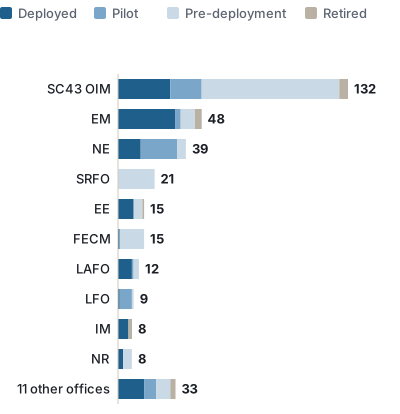
The Office of Science laboratories, the 7 bureaus coded "SC43 OIM" (Argonne, Brookhaven, Fermilab, Oak Ridge, Pacific Northwest, Princeton Plasma Physics and SLAC), hold 132 of DOE's 340 rows, 79 of them before deployment.[1] Environmental Management sites ("EM") hold 48, 33 of them deployed, and the Savannah River Site ("SRFO") another 21, all before deployment.[1] Nuclear Energy, which reports through Idaho National Laboratory ("NE"), lists 39, 21 of them pilots; Energy Efficiency and Renewable Energy ("EE", its headquarters and NREL) 15, with 9 deployed; Fossil Energy and Carbon Management, through NETL ("FECM"), 15, 14 before deployment; Naval Reactors ("NR") 8; the 3 power marketing administrations ("PMA") 5 between them; and the Grid Deployment Office ("GDO") 1.[1]
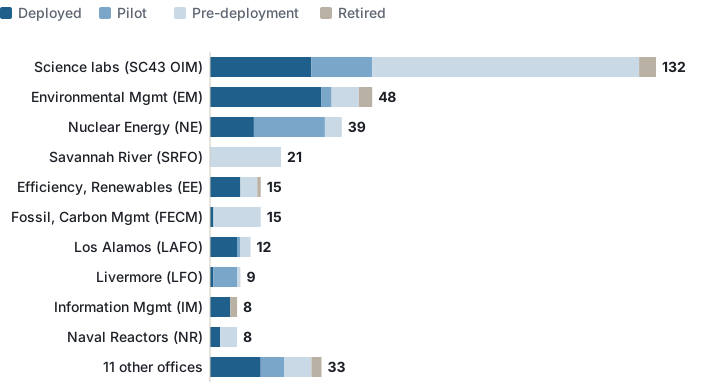
| Office code, as in the file | Bureaus under it | Deployed | Pilot | Pre-deployment | Retired | Total | High-impact |
|---|---|---|---|---|---|---|---|
| SC43 OIM | 7 | 30 | 18 | 79 | 5 | 132 | 19 |
| EM | 4 | 33 | 3 | 8 | 4 | 48 | 2 |
| NE | 1 | 13 | 21 | 5 | 0 | 39 | 7 |
| SRFO | 1 | 0 | 0 | 21 | 0 | 21 | 0 |
| EE | 2 | 9 | 0 | 5 | 1 | 15 | 0 |
| FECM | 1 | 1 | 0 | 14 | 0 | 15 | 0 |
| LAFO | 1 | 8 | 1 | 3 | 0 | 12 | 0 |
| LFO | 1 | 1 | 7 | 1 | 0 | 9 | 0 |
| IM | 2 | 6 | 0 | 0 | 2 | 8 | 0 |
| NR | 1 | 3 | 0 | 5 | 0 | 8 | 0 |
| LM | 1 | 3 | 2 | 0 | 0 | 5 | 0 |
| NNSA HQ | 1 | 3 | 1 | 1 | 0 | 5 | 0 |
| PMA | 3 | 1 | 1 | 1 | 2 | 5 | 0 |
| KCFO | 1 | 1 | 2 | 1 | 0 | 4 | 0 |
| PFO | 1 | 0 | 0 | 4 | 0 | 4 | 1 |
| YFO | 1 | 4 | 0 | 0 | 0 | 4 | 0 |
| EHSS | 1 | 1 | 1 | 0 | 0 | 2 | 0 |
| GDO | 1 | 0 | 0 | 1 | 0 | 1 | 0 |
| HC | 1 | 1 | 0 | 0 | 0 | 1 | 0 |
| PA | 1 | 0 | 0 | 0 | 1 | 1 | 0 |
| PM | 1 | 1 | 0 | 0 | 0 | 1 | 0 |
Data: doe-by-office-2025.csv (with the bureau names under each code)
What it is for
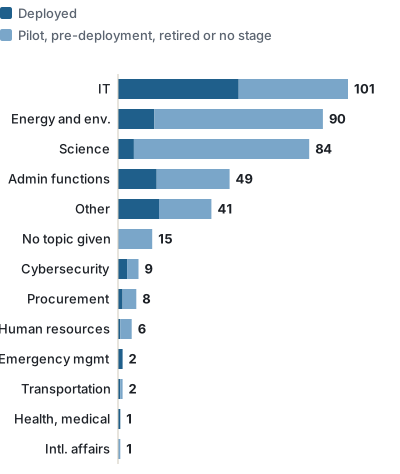
By topic, IT is the largest for the four agencies with 101 of the 409 rows, 53 of them deployed; "Energy and Environment" has 90 (16 deployed), science 84 and administrative functions 49.[1][2] Generative AI is the label on 156 rows and on 70 of the 122 deployed ones; classical machine learning on 105 and agentic AI on 13.[1]
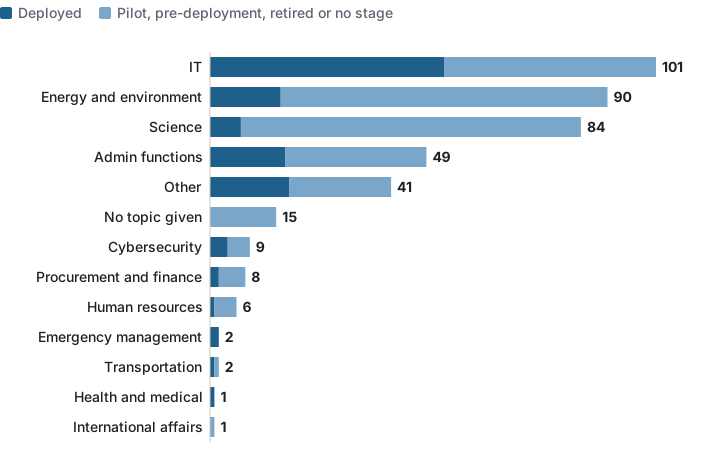
DOE's 40 rows under "Energy and Environment" show the energy work by name: at EERE, "Energy Wizard", "LLM EV", "WETO SA" and 3 "Ask" assistants, all deployed; at NETL, carbon-storage tools such as "NRAP-Open-IAM", "Smart CO2 Transport-Route Planning Tool"; at the Grid Deployment Office, "Argonne Resilience AI Assistant ARAIA (nee CALLM)"; and at the science laboratories, "PermitAI", "Regional waste feedstock conversion to biofuels".[1] TVA files 41 of its 59 rows under that topic, among them "Azure Nuclear Permitting Solution", "Load Forecasting", "Transmission analytics", "Vegetation Management".[1]
Data: doe-energy-topic-rows-2025.csv · energy-by-classification-2025.csv
The high-impact uses
DOE marks 29 use cases high-impact and FERC, the NRC and TVA none.[1] 19 are the science laboratories' and 10 of those are Oak Ridge's pre-deployment program lines, "ORNL: AI for Advanced Manufacturing", "ORNL: AI for Bio and Health Sciences", "ORNL: AI for Earth Systems" and 7 more.[1] Nuclear Energy's 7 include "Advanced Fuels Campaign", "Custom GenAI for Advanced Reactor Development (LotusAI)", "Nuclear Safety Analysis".[1] 5 more DOE rows were presumed high-impact and determined not to be.[1]
Data: energy-high-impact-2025.csv
FERC, the NRC and TVA
FERC's 6 rows are a deployed comment-summarizing tool, a pilot on gas blanket certificates and pre-deployment work on interconnection requests, market surveillance, safety inspections and legal research.[1] The NRC's 4 are 2 deployed generative-AI tools for staff text retrieval and routine tasks and 2 pre-deployment rows on access to and testing of large language models.[1] TVA's 59 names run from load and river forecasting to Copilot.[1]
| Agency | Use case, as named in the file | Stage | Topic |
|---|---|---|---|
| FERC | AI Enabled Assistant Legal Research | Pre-deployment | Other |
| FERC | Enhance Market Surveillance and Fraud Detection Use Case | Pre-deployment | Energy and Environment |
| FERC | Gas Blanket Certificates (Permitting) | Pilot | Energy and Environment |
| FERC | Improve Safety Inspections Use Case | Pre-deployment | Energy and Environment |
| FERC | Summarization & Policy Analysis for Regulatory Comments (originally Leverage AI in the Rulemaking Process Use Case) | Deployed | Energy and Environment |
| FERC | Support Interconnection Request Responses Use Case | Pre-deployment | Energy and Environment |
| NRC | Support routine administrative tasks and enhancing communications | Deployed | Energy and Environment |
| NRC | Testing industry leading generative AI foundational large language models | Pre-deployment | Energy and Environment |
| NRC | Text Retrieval and Generation for NRC Staff Support | Deployed | Energy and Environment |
| NRC | Unified, secure access to multiple advanced AI language models | Pre-deployment | Energy and Environment |
Data: ferc-nrc-tva-rows-2025.csv (with every TVA name)
The words grid, energy, nuclear across the file
A search of every use case's name and problem statement for grid, energy, power, nuclear, reactor, electricity, utility and battery (whole words, singular and plural, "high-energy" and other hyphenated compounds included; Microsoft's "Power BI", "Power Platform" and "Power Automate" removed first) finds 86 rows, 33 of them in the four agencies.[1] "energy" is the word found most often, in 39 rows; "grid" is in 2 and "reactor" in 7, all of them in the four agencies.[1] Outside them, NASA has 18 matching rows and Interior 16, among them "Automated power line extraction using deep learning", "Geothermal Energy Assessments".[1] The topic "Energy and Environment" is wider than the four agencies too: 131 rows across the file, 25 of them Interior's and 14 USDA's.[1]
Data: energy-keywords-2025.csv · energy-keywords-by-agency-2025.csv · energy-keyword-rows-other-agencies-2025.csv · energy-topic-by-agency-2025.csv
What the agencies' own documents say
DOE's AI strategy of October 2025 lists use cases under four headings, departmental operations, national security, scientific discovery and "AI for Energy Dominance"; the energy heading names autonomous reactor operation, nuclear maintenance costs, the GEMINA digital-twin program, fusion plasma control, "Physics-informed ML for Power Grid Control", a pipeline integrity model and PermitAI, built on "120,000 NEPA documents from 50 years" of reviews.[4] The department's topic page, headed "Super Intelligence", puts the Genesis Mission first, says "Data centers are projected to consume up to 9%" of U.S. electricity demand by 2030, and describes adversarial testing against "cyber threats to the power grid".[5] The department's FASST page was not consulted.
The NRC's strategic plan, NUREG-2261 of May 2023, anticipates "increased use of AI in NRC-regulated activities" and sets five goals, the last to "pursue use cases to build an AI foundation across the NRC".[6]
The earlier site's posts on AI in power plants, oil and gas exploration and data centers are retired.
Counting caveats
- The office codes are the file's own labels, expanded from DOE's strategy where it names the office; "SC43 OIM" rows count as the Office of Science's because the bureau names under that code are its laboratories.[1][4]
- Commerce, Education and TVA rows carry no development stage, classification or high-impact mark; TVA's carry a topic but no problem statement, so the keyword search reaches only their names.[1]
- The inventory excludes AI used for research unless it is meant for agency use, which matters for laboratories.[3]
- Topic, classification, stage and the high-impact answer are each one choice by the reporting agency.[2]
- Common tasks done with off-the-shelf products go in a separate consolidated file, not in the 409; DOE links its own copy of the inventory from its topic page.[3][5]
See also: AI in environment and weather, AI in defense, AI in government IT and cybersecurity, AI in the public sector, Data science in government, The energy use of AI: what happened since, and the data story 3,611 uses of AI on the federal list.
Sources
- Office of Management and Budget, 2025 Federal Agency AI Use Case Inventory, file of individually reported use cases (3,611 rows; the repository says "as of April 13, 2026"), counted by this site: 2025_individually_reported_AI_use_cases.csv. Read 28 October 2026.
- Office of Management and Budget, 2025 inventory data dictionary. Read 28 October 2026.
- Office of Management and Budget, 2025 Federal Agency AI Use Case Inventory repository, README (summary, submission schedule and exclusion criteria). Read 28 October 2026.
- U.S. Department of Energy, Artificial Intelligence Strategy, October 2025 (linked from the department's AI strategy page, dated 1 October 2025). Read 29 October 2026.
- U.S. Department of Energy, Super Intelligence, the department's topic page on AI (the Genesis Mission, infrastructure, responsible AI and the links to its AI strategy, compliance plan and use case inventory). Read 29 October 2026.
- U.S. Nuclear Regulatory Commission, Artificial Intelligence Strategic Plan: Fiscal Years 2023-2027 (NUREG-2261), published May 2023 (the publication page with its abstract). Read 29 October 2026.
How this page was counted: one row per use case in OMB's file, read on 28 October 2026. A use case is in the set when its agency column is exactly "DOE", "FERC", "NRC" or "TVA"; DOE's program office is the code in the last pair of parentheses of the agency_bureau cell. The keyword reading takes rows anywhere in the file whose use_case_name or problem_solved contains grid, energy, power, nuclear, reactor(s), electricity, utility, utilities, battery or batteries as a whole word, case-insensitive (a hyphen is a word boundary, so a hyphenated compound such as "high-energy" matches), after "Power BI", "Power Platform", "Power Automate", "Power Apps" and "Power Pages" are removed from the text; the topic reading takes rows whose topic_area is "Energy and Environment". Stages, topics, classifications and high-impact answers are those columns as given; an empty cell is "no stage given", "no topic given" or "no answer". The CSV files beside this page carry the counts, the source address and the read date; README.txt beside them repeats the rule.