Guide · Public communications
AI in public communications
Chatbots, call centres, translation and plain language: which federal AI use cases are about the channels through which agencies talk with people, how many of them name the public, and what the digital-service law and OMB's guidance require of them. Counted from the public inventory with a stated rule.
The counting rule
OMB's 2025 inventory has no topic called communications, so this page defines one.[2] A row is in the set when its use case name or problem statement contains, as a whole word, singular or plural, one of 19 channel terms: "chatbot", "chat bot", "virtual assistant", "virtual agent", "voicebot", "voice bot", "call center", "contact center", "FAQ", "translation", "plain language", "social media", "customer service", "public inquiries", "correspondence", "interactive voice response", "IVR", "311", "press release".[1] Within the set, a row "names an outside audience" when the same two columns also contain one of 13 audience words: "public", "citizen", "taxpayer", "veteran", "applicant", "customer", "caller", "visitor", "constituent", "traveler", "beneficiary", "borrower", "student".[1] The rule reads words, not intent: a help-desk chatbot for staff is in the set, and a row that says "the public" once is in the subset. 2 of the channel terms, "311", "press release", match no row at all.[1]
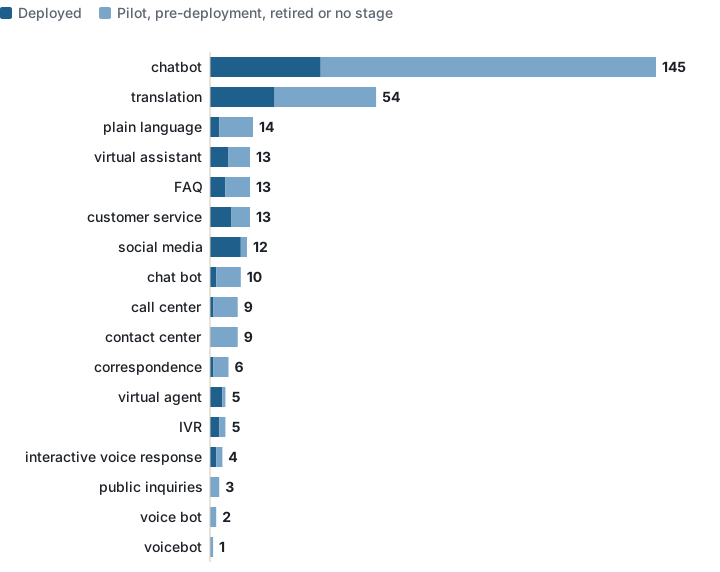
How many
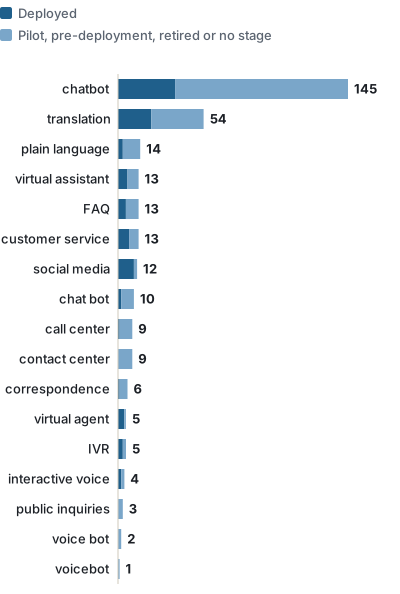
The rule gives 282 of the 3,611 use cases, and 70 of those name an outside audience.[1] "Chatbot" alone matches 145 rows and "translation" 54; "social media" matches 12, of which 10 are deployed.[1] Of the 282, 89 are marked deployed, 43 are pilots, 111 are before deployment, 25 are retired and 14 carry no stage; so 32% of the set is deployed, against 29% of the whole file.[1]
Generative AI is the label on 131 of the 282 and natural language processing on 78.[1] The topics the agencies chose say where these tools sit: 57 are filed under administrative functions and 55 under IT, against 35 under service delivery and 8 under benefits processing.[1][2]
| Set | Deployed | Pilot | Pre-deployment | Retired | No stage given | Total |
|---|---|---|---|---|---|---|
| Communications set | 89 | 43 | 111 | 25 | 14 | 282 |
| Of which names an outside audience | 28 | 5 | 33 | 2 | 2 | 70 |
| All 3,611 use cases | 1040 | 440 | 1479 | 314 | 338 | 3611 |
Data: comms-by-stage-2025.csv · comms-by-topic-2025.csv · comms-by-classification-2025.csv
Which agencies
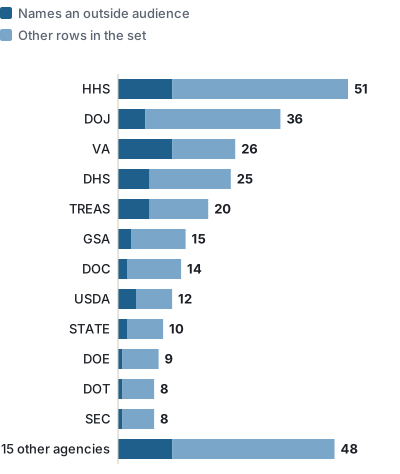
Department of Health and Human Services lists 51 rows in the set, then Department of Justice 36, Department of Veterans Affairs 26, Department of Homeland Security 25, Department of the Treasury 20.[1] Measured against each agency's whole list, the Social Security Administration has 7 of its 33 rows in the set and the General Services Administration 15 of 49, while NASA has 6 of 425.[1] The two agencies with the most rows in the outside-audience subset are Department of Health and Human Services with 12 and Department of Veterans Affairs with 12.[1]
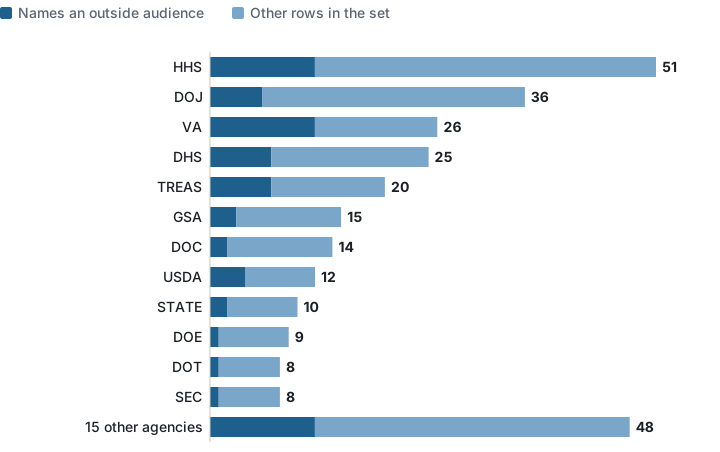
| Agency, as named in the file | In the set | Deployed | No stage given | Names an outside audience | Of which deployed | All the agency's rows |
|---|---|---|---|---|---|---|
| Department of Health and Human Services (HHS) | 51 | 20 | 0 | 12 | 6 | 447 |
| Department of Justice (DOJ) | 36 | 15 | 0 | 6 | 1 | 314 |
| Department of Veterans Affairs (VA) | 26 | 5 | 0 | 12 | 3 | 367 |
| Department of Homeland Security (DHS) | 25 | 6 | 0 | 7 | 3 | 238 |
| Department of the Treasury (TREAS) | 20 | 6 | 0 | 7 | 3 | 129 |
| General Services Administration (GSA) | 15 | 4 | 0 | 3 | 0 | 49 |
| Department of Commerce (DOC) | 14 | 0 | 14 | 2 | 0 | 223 |
| Department of Agriculture (USDA) | 12 | 2 | 0 | 4 | 1 | 162 |
| Department of State (STATE) | 10 | 5 | 0 | 2 | 1 | 60 |
| Department of Energy (DOE) | 9 | 3 | 0 | 1 | 1 | 340 |
| Department of Transportation (DOT) | 8 | 3 | 0 | 1 | 1 | 70 |
| Securities and Exchange Commission (SEC) | 8 | 2 | 0 | 1 | 0 | 60 |
| Social Security Administration (SSA) | 7 | 6 | 0 | 3 | 3 | 33 |
| Department of Labor (DOL) | 6 | 3 | 0 | 2 | 2 | 41 |
| National Aeronautics and Space Administration (NASA) | 6 | 0 | 0 | 1 | 0 | 425 |
| Small Business Administration (SBA) | 5 | 0 | 0 | 1 | 0 | 34 |
| Department of the Interior (DOI) | 4 | 0 | 0 | 0 | 0 | 247 |
| Federal Deposit Insurance Corporation (FDIC) | 4 | 3 | 0 | 0 | 0 | 50 |
| Federal Trade Commission (FTC) | 4 | 2 | 0 | 1 | 1 | 16 |
| Department of Housing and Urban Development (HUD) | 3 | 0 | 0 | 0 | 0 | 11 |
| Election Assistance Commission (EAC) | 2 | 0 | 0 | 0 | 0 | 4 |
| National Science Foundation (NSF) | 2 | 1 | 0 | 2 | 1 | 17 |
| Environmental Protection Agency (EPA) | 1 | 1 | 0 | 1 | 1 | 29 |
| Federal Housing Finance Agency (FHFA) | 1 | 1 | 0 | 0 | 0 | 16 |
| Federal Reserve Board (FRB) | 1 | 1 | 0 | 0 | 0 | 38 |
| National Endowment for the Arts (NEA) | 1 | 0 | 0 | 1 | 0 | 4 |
| Pension Benefit Guaranty Corporation (PBGC) | 1 | 0 | 0 | 0 | 0 | 17 |
The rows that name the public
The 70 rows that name an outside audience are published in full beside this page; 28 are deployed.[1] They include the Social Security Administration's "SSA 800# Public Question & Answer Bot and OIG Hotline recording of fraud, waste and abuse.", marked deployed; the Internal Revenue Service's "Taxpayer Services Chatbot", deployed, which the agency says answers questions on refunds, amended returns and employer identification numbers; the Transportation Security Administration's "AskTSA", deployed; and the Department of Veterans Affairs' "VA.gov Chatbot: Summative Content", deployed and marked high-impact.[1] GSA's "AI in Public Experience (PX) Contact Center Services Blanket Purchase Agreement (BPA)" is a contract vehicle rather than a tool, still pre-deployment.[1]
9 of the 70 are marked high-impact, OMB's term for AI whose output "serves as a principal basis for decisions or actions" with a legal, material, binding or significant effect.[1][6] Among them are the VA's chatbot above and its "VA VoiceBot for Call Center Modernization", a voice bot for veterans' calls still before deployment.[1] Across the whole set, 27 rows are high-impact, 220 are not, and 32 give no answer.[1]
| Agency | Use case, as named in the file | Topic | High-impact |
|---|---|---|---|
| DHS | CBP Careers Bot - Leo | Service delivery | Not High-impact |
| DHS | Public Information Compilation for Travel Threat Analysis (Dataminr) | Administrative functions | Presumed High-Impact, but Not High-impact |
| DHS | AskTSA | Service delivery | Not High-impact |
| DOE | ServiceNow Virtual Agent | IT | Not High-impact |
| DOJ | Data & Analytics: Database Tools | Law enforcement | High-impact |
| DOL | Workforce Recruitment Program (WRP) Website Chatbot Assistant | Service delivery | Not High-impact |
| DOL | Audio Transcription | Other | Not High-impact |
| DOT | Community Engagement Chat Bot | Transportation | Not High-impact |
| EPA | Helpdesk chat assistant for common data system tasks | IT | Not High-impact |
| FTC | IVR Automated Voice Assistant | Other | Not High-impact |
| HHS | NCIRD SmartFind ChatBots - Public and Internal | Administrative functions | Not High-impact |
| HHS | Sidekick Comms bot Offering User-friendly Tips (SCOUT) | Administrative functions | Not High-impact |
| HHS | CCSQ Now Assist for CSM | IT | Not High-impact |
| HHS | Electronic translational services for regulatory documents for articles offered for import | IT | Not High-impact |
| HHS | CSR Public Chatbot (CPC) | Administrative functions | Not High-impact |
| HHS | Applicant Help Chatbot | Service delivery | Not High-impact |
| NSF | ServiceNow GenAI "Now Assist" | No topic given | (no answer) |
| SSA | PolicyNet Plain Language Search Engine | Administrative functions | Not High-impact |
| SSA | Generative Artificial Intelligence (AI) for Analytic Insights | IT | Not High-impact |
| SSA | SSA 800# Public Question & Answer Bot and OIG Hotline recording of fraud, waste and abuse. | Service delivery | Not High-impact |
| STATE | Digital Media Analytics Platform | International Affairs | Not High-impact |
| TREAS | SBSE - Payments Topics Chatbot | Service delivery | Not High-impact |
| TREAS | Taxpayer Services Chatbot | Service delivery | Not High-impact |
| TREAS | OCC.Chat | IT | Not High-impact |
| USDA | Chatbot for IT Customer Help Desk | IT | Not High-impact |
| VA | Automated Claims Processing | Benefits Processing | High-impact |
| VA | VA.gov Chatbot: Summative Content | IT | High-impact |
| VA | Customer Sentiment | HR | Not High-impact |
Data: comms-outside-audience-rows-2025.csv · comms-high-impact-2025.csv
Translation and the high-impact line
"Translation" is the second-largest channel term, with 54 rows, 21 of them deployed; 8 of the translation rows also name an outside audience.[1] 3 of those are marked high-impact: the Department of Homeland Security's "USCIS Speech Translation Service", for "live applicant interactions in USCIS offices", pre-deployment; the Department of Justice's "Immigration Hearing Transcription and Translation/Interpretation Services", pre-deployment; the Department of State's "Live Consular AI Language Augmentation (LCALA) - Visa Interview Pilot", for visa interviews, pilot.[1] That matches OMB's list of uses presumed high-impact, which names "provision of language translation" when the responses are legally binding or the interaction "directly informs an agency decision or action".[6]
What the law and OMB ask
The 21st Century Integrated Digital Experience Act of 2018 does not mention AI. It requires that a new or redesigned public website "contains a search function", is "fully functional and usable on common mobile devices", and that paper forms "related to serving the public" be made digital within two years; it also requires agencies to keep "an accessible method of completing digital services" in person or on paper.[4] OMB's guidance on the Act, M-23-22 of September 2023, lists "phone and contact centers", chat and social media among the channels agencies should consider, and names "customer call center support" that could become self-service as a candidate for digitization.[5] On translation it says agencies should "not rely on auto-translation alone" and should test with native speakers rather than rely "solely upon machine translation services".[5] It also observes that public web content may be scraped "for the training of large language models that enable artificial intelligence chatbots".[5]
The earlier version of this site ran seven general posts on AI in marketing, advertising and communications. They are retired; what a federal reader can check is the list above and the documents behind it.
Counting caveats
- The set is a word rule over two text columns. It includes internal help-desk chatbots and misses a public-facing tool whose row never uses one of the 19 terms.[1]
- "Names an outside audience" is also a word rule; "customer" in some rows means an internal customer, and a row can name the public in a benefits or outputs column the rule does not read.[1]
- A row can match several terms, so the per-term counts in the chart add to more than 282.[1]
- The Department of Commerce reports no stage for any of its rows in the set, 14 rows in all, so those rows count as "no stage given".[1]
- Topic, classification, stage and the high-impact answer are each one choice by the reporting agency.[2]
See also: AI in the public sector, Generative AI in government, AI in government IT and cybersecurity, AI in health, AI in culture and the arts, Data science in government, and the data story 3,611 uses of AI on the federal list.
Sources
- Office of Management and Budget, 2025 Federal Agency AI Use Case Inventory, file of individually reported use cases (3,611 rows; the repository says "as of April 13, 2026"), counted by this site: 2025_individually_reported_AI_use_cases.csv. Read 28 October 2026.
- Office of Management and Budget, 2025 inventory data dictionary. Read 28 October 2026.
- Office of Management and Budget, 2025 Federal Agency AI Use Case Inventory repository, README (summary, submission schedule and exclusion criteria). Read 28 October 2026.
- Public Law 115-336, 21st Century Integrated Digital Experience Act, approved 20 December 2018 (govinfo). Read 29 October 2026.
- OMB Memorandum M-23-22, Delivering a Digital-First Public Experience, 22 September 2023. Read 29 October 2026.
- OMB Memorandum M-25-21, Accelerating Federal Use of AI through Innovation, Governance, and Public Trust, 3 April 2025. Read 29 October 2026.
How this page was counted: one row per use case in OMB's file, read on 28 October 2026. A row is in the set when its use_case_name or problem_solved column contains, as a whole word, case-insensitive, singular or plural (US or UK spelling of "center"), one of the channel terms chatbot, chat bot, virtual assistant, virtual agent, voicebot, voice bot, call center, contact center, FAQ, translation, plain language, social media, customer service, public inquiries, correspondence, interactive voice response, IVR, 311, press release; it names an outside audience when the same columns also contain one of public, citizen, taxpayer, veteran, applicant, customer, caller, visitor, constituent, traveler, beneficiary, borrower, student. Stages, topics, classifications and high-impact answers are those columns as given, with an empty cell counted as "no stage given", "no topic given" or "no answer". README.txt beside the CSV files repeats the rule.