Guide · Culture and the arts
AI in culture and the arts
What the National Archives and the National Endowment for the Arts say they use AI for, which other agencies' AI touches archives, manuscripts and museums, and what the two cultural agencies' own pages and policies add. Counted from the public inventory with a stated rule.
The public record
Federal agencies list their AI use cases each year and OMB compiles the lists into one public file of 3,611 rows.[3][1] Two cultural agencies appear in it under their own names: the National Archives and Records Administration as "NARA" and the National Endowment for the Arts as "NEA".[1] The file's agency and agency name columns do not name the 5 other bodies a reader might look for here: the Smithsonian, the Library of Congress, the National Endowment for the Humanities, the Institute of Museum and Library Services, the National Park Service.[1] The National Park Service does appear as a bureau value, "NPS", of the Department of the Interior, with 2 rows, and none of them matches the rule.[1]
The counting rule
A row is in this page's set when its agency is NARA or NEA, or when its use case name or problem statement contains, as a whole word, singular or plural, one of "museum", "archive", "archival", "manuscript", "cultural", "heritage".[1] Three more words were tested and left out: "art" matched 15 rows, among them patent "prior art" searches, "state of the art" and acronyms; "collection" matched 29, including rows about data collection; "library" matched 18, among them a Python library and internal document libraries.[1] The matches of every tested word are published so that a reader can see what the wider rule would have added.[1]
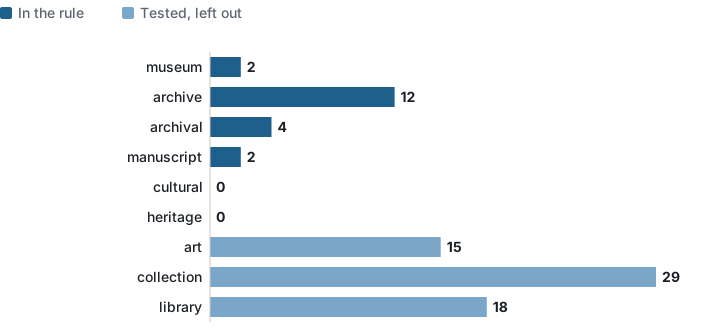
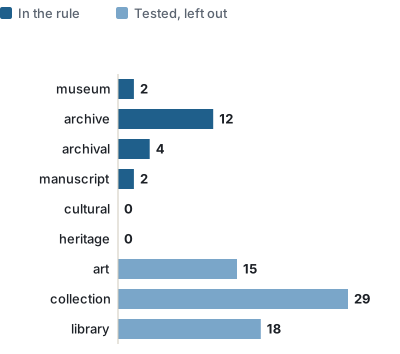
| Word (whole word, singular or plural) | Rows matched | Agencies matched | In the rule |
|---|---|---|---|
| museum | 2 | 2 | yes |
| archive | 12 | 4 | yes |
| archival | 4 | 1 | yes |
| manuscript | 2 | 2 | yes |
| cultural | 0 | 0 | yes |
| heritage | 0 | 0 | yes |
| art | 15 | 8 | no |
| collection | 29 | 16 | no |
| library | 18 | 9 | no |
How many
The rule gives 30 of the 3,611 use cases: 14 from NARA, 4 from NEA and 12 from 5 other agencies, found by a keyword.[1] Of the 30, 5 are marked deployed, 3 are pilots, 20 are before deployment and 2 are retired, against 29% deployed in the whole file.[1] None of the 30 is marked high-impact.[1]
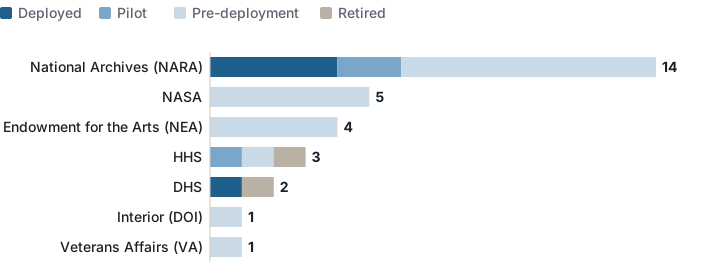
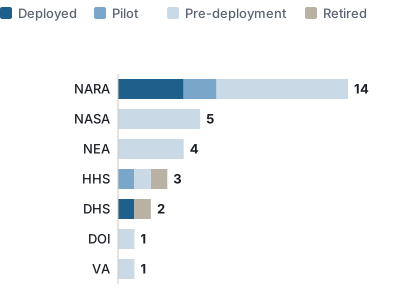
| Agency, as named in the file | Deployed | Pilot | Pre-deployment | Retired | Total | By agency rule | By keyword |
|---|---|---|---|---|---|---|---|
| National Archives and Records Administration (NARA) | 4 | 2 | 8 | 0 | 14 | 14 | 0 |
| National Aeronautics and Space Administration (NASA) | 0 | 0 | 5 | 0 | 5 | 0 | 5 |
| National Endowment for the Arts (NEA) | 0 | 0 | 4 | 0 | 4 | 4 | 0 |
| Department of Health and Human Services (HHS) | 0 | 1 | 1 | 1 | 3 | 0 | 3 |
| Department of Homeland Security (DHS) | 1 | 0 | 0 | 1 | 2 | 0 | 2 |
| Department of the Interior (DOI) | 0 | 0 | 1 | 0 | 1 | 0 | 1 |
| Department of Veterans Affairs (VA) | 0 | 0 | 1 | 0 | 1 | 0 | 1 |
Data: culture-by-stage-2025.csv · culture-matching-rows-2025.csv
The National Archives
NARA's 14 rows are all filed under the topic "Other", and all 14 are marked not high-impact.[1] 7 are classified generative AI and 7 natural language processing; 11 say they were developed in-house.[1] The 4 deployed ones are "A1 Museum AI Project", "Amelia Earhart AI Search", "Generative AI Solutions for Workplace Productivity (aka Gemini)", "NARA@WORK Kendra Search".[1] The pilots screen digitized records for personal information and test semantic search of the National Archives Catalog; the pre-deployment rows include auto-filled descriptive metadata, a FOIA discovery tool, an Archives.gov search and a chat interface to "Interact With the Archival Documents".[1]
NARA's own inventory page, which now calls the subject "super intelligence", describes the same projects with a status for each.[4] It says the museum project uses a commercial model "to automatically generate tags and topics for approximately 2 million digital records", that the Earhart search was built to release records "in compliance with the Presidential directive of September 26, 2025", and that the catalog search pilot chose one cloud platform after testing open-source models and another vendor's model.[4] Its summary table also lists a declassification pilot for the National Declassification Center and a plan to train a large language model on the Electronic Records Archives, both "Planned for future pilot", which do not appear as rows in OMB's file.[4][1]
| Use case, as named in the file | Stage | Type of AI | Built by |
|---|---|---|---|
| A1 Museum AI Project | Deployed | Generative AI | Contracting and In House |
| Amelia Earhart AI Search | Deployed | Natural language processing | In-house Development |
| Generative AI Solutions for Workplace Productivity (aka Gemini) | Deployed | Generative AI | Vendor Purchased |
| NARA@WORK Kendra Search | Deployed | Natural language processing | In-house Development |
| AI based Semantic Search for National Archives Catalog (aka ArchiAI) | Pilot | Natural language processing | In-house Development |
| AI Pilot Project to Screen and Flag for Personally Identifiable Information (PII) in Digitized Archival Records | Pilot | Generative AI | In-house Development |
| Archives.gov AI search | Pre-deployment | Natural language processing | In-house Development |
| Auto-fill of Descriptive Metadata for Archival Descriptions | Pre-deployment | Generative AI | In-house Development |
| Automated Data Discovery and Classification Pilot | Pre-deployment | Generative AI | In-house Development |
| Create an AI based knowledge articles user interface for working with CRG documents | Pre-deployment | Natural language processing | In-house Development |
| Develop a Natural Language Based Chat Interface (like ChatGPT) to Interact With the Archival Documents | Pre-deployment | Generative AI | In-house Development |
| EOP 42 Search PoC using AI Based Semantic Search | Pre-deployment | Natural language processing | Contracting and In House |
| Freedom of Information Act (FOIA) Discovery AI Pilot | Pre-deployment | Natural language processing | In-house Development |
| Topic Summarizer and Entity Extraction using AI | Pre-deployment | Generative AI | In-house Development |
The Endowment for the Arts
NEA's 4 rows are all before deployment: "Categorizing Grant Subjects from Grant Applicants", "External "Public Facing" Chatbot", "Managing Cybersecurity Controls", "Managing Help Desk Tickets - Self Service".[1] None touches the judging of art; 1 names the grant process in its title, "Categorizing Grant Subjects from Grant Applicants", and the public chatbot is for "grant applicant and NEA constituent questions".[1]
The agency's AI strategy, approved on 4 March 2026 as version 2.1, sets a five-phase review that runs from use case to integration, with an AI Council chaired by the chief AI officer, and promises a decision "within 90 days" of a request entering the second phase.[5] Its rules for conditionally approved commercial tools say they "may not be used in the decision-making process for any grant awards", that staff must not put data about individuals into them, and that staff are not to input copyrighted content without permission or reuse AI-generated works produced by third parties.[5] The compliance plan of September 2025 says the chief information officer also holds the chief AI officer role and that a development environment is being created to pilot AI tools before wider release.[6]
Archives and manuscripts elsewhere
The keyword rule adds 12 rows from other agencies, and in NASA's rows the word "archive" names a science data archive rather than a cultural one: its 5 rows name an Earth science image archive, an X-ray spectra archive, a circulars archive and satellite data archives.[1] The two "manuscript" rows are a copyediting tool for scientific manuscripts at the National Institutes of Health and a Geological Survey tool that reads manuscripts and datasets.[1] The two museum rows are NARA's and a Department of Veterans Affairs "Augmented Reality and Virtual Museum", still before deployment.[1] The Department of Agriculture's "NAL Automated Indexing", a deployed indexing tool of its library, is outside the rule because "library" was left out; it is the kind of row the wider rule would have added.[1]
The earlier version of this site ran eight general posts on AI in art, entertainment and games. They are retired; what a reader can check is the list above and the two agencies' own documents.
Counting caveats
- The inventory covers executive agencies that report to OMB; a cultural body absent from the agency column is absent from this page, not necessarily free of AI.[3][1]
- The keyword rule reads only the use case name and the problem statement, not the benefits or outputs columns; a row that names an archive only there is missed.[1]
- "Archive" in NASA's rows means a science data archive; the rule cannot tell that from a records archive, so the NASA rows are listed and named rather than treated as cultural work.[1]
- NARA's own page lists projects that are not rows in OMB's file; the counts here are OMB's rows only.[4][1]
- Topic, classification, stage and the high-impact answer are each one choice by the reporting agency.[2]
See also: AI in the public sector, Generative AI in government, AI in public communications, AI in education and research, Data science in government, and the data story 3,611 uses of AI on the federal list.
Sources
- Office of Management and Budget, 2025 Federal Agency AI Use Case Inventory, file of individually reported use cases (3,611 rows; the repository says "as of April 13, 2026"), counted by this site: 2025_individually_reported_AI_use_cases.csv. Read 28 October 2026.
- Office of Management and Budget, 2025 inventory data dictionary. Read 28 October 2026.
- Office of Management and Budget, 2025 Federal Agency AI Use Case Inventory repository, README (summary, submission schedule and exclusion criteria). Read 28 October 2026.
- National Archives and Records Administration, Inventory of NARA Super Intelligence (SI) Use Cases (the agency's inventory page; "last reviewed on October 16, 2026"). Read 29 October 2026.
- National Endowment for the Arts, Office of Information and Technology Management, Artificial Intelligence (AI) Strategy and Procedures, Information Policy AI0001, version 2.1, 4 March 2026. Read 29 October 2026.
- National Endowment for the Arts, NEA Compliance Plan for OMB Memoranda M-25-21, September 2025. Read 29 October 2026.
How this page was counted: one row per use case in OMB's file, read on 28 October 2026. A row is in the set when its agency column is exactly "NEA" or "NARA", or when its use_case_name or problem_solved column contains, as a whole word, case-insensitive, singular or plural, one of museum, archive, archival, manuscript, cultural, heritage; "art", "collection" and "library" were tested and left out, and their match counts are published. Stages, topics, classifications, contracting answers and high-impact answers are those columns as given, with an empty cell counted as "no answer" or "no topic given". README.txt beside the CSV files repeats the rule.