Guide · Education and research
AI in education and research
What the Department of Education and the National Science Foundation list, how the National Institutes of Health and NASA use AI on the research process rather than in the laboratory, and what the department's grant priority and NSF's research resource say. Counted from the public inventory with a stated rule.
The public record
Federal agencies list their AI use cases each year and OMB compiles the lists into one public file of 3,611 rows.[3][1] OMB's exclusion criteria leave out AI "used to carry out basic research or applied research" unless the research is meant to produce an application for agency use, is already influencing decisions about individuals, or has an agreement to move into operations.[3] What remains for this page is the administration of education and research: the Department of Education's own tools, NSF's, and the parts of NIH's and NASA's lists that are about the grant process or that name research.[1]
The counting rule
A row is in the set when its agency is "ED" or "NSF"; when its bureau is "HHS/NIH" and its use case name or problem statement contains, as a whole word, singular or plural, one of "grant", "grant application", "peer review", "reviewer", "study section", "referral", "proposal", "program officer"; or when its agency is "NASA" and the same columns contain one of "research", "researcher", "scientist", "scientific".[1] The two word rules are deliberately narrow: NIH's clinical and laboratory rows that never name the grant process are out, and so are NASA rows that describe a model without using a research word.[1]
How many
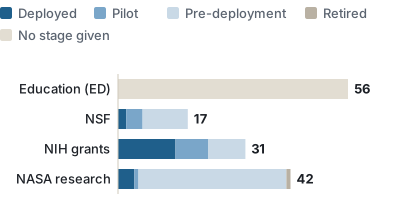
The rule gives 146 rows: all 56 of the Department of Education's, all 17 of NSF's, 31 of NIH's 124, and 42 of NASA's 425.[1] 20 are marked deployed, 13 are pilots, 56 are before deployment and 1 is retired; 56 carry no stage, and every one of those is a Department of Education row.[1] None of the 146 is marked high-impact.[1]
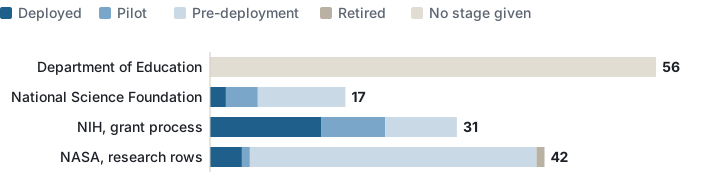
| Part of the rule | Deployed | Pilot | Pre-deployment | Retired | No stage given | Total | Rows in the parent list |
|---|---|---|---|---|---|---|---|
| Department of Education (all rows) | 0 | 0 | 0 | 0 | 56 | 56 | 56 (all ed rows) |
| National Science Foundation (all rows) | 2 | 4 | 11 | 0 | 0 | 17 | 17 (all nsf rows) |
| NIH rows naming the grant process | 14 | 8 | 9 | 0 | 0 | 31 | 124 (all hhs/nih rows) |
| NASA rows using a research word | 4 | 1 | 36 | 1 | 0 | 42 | 425 (all nasa rows) |
| Whole set | 20 | 13 | 56 | 1 | 56 | 146 | 3,611 (all 3,611 rows) |
Data: edu-matching-rows-2025.csv · edu-term-tests-2025.csv
The Department of Education
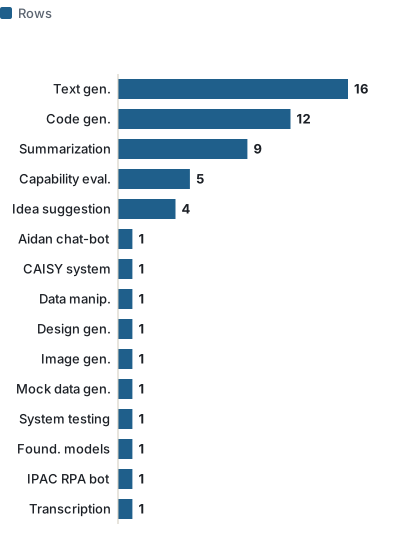
The department's 56 rows are unlike the rest of the file. None of them fills the stage, topic, classification or high-impact column; every one fills the problem and benefits columns, and the problem column holds 16 distinct texts across 17 offices, each a description of the office rather than a problem.[1] 51 of the 56 are named for a generative-AI task, "Text Generation", "Code Generation", "Information Summarization", "Capability Evaluation", "Idea Suggestion", "Data Manipulation", "Design Generation", "Image Generation", "Mock Data Generation", "System Testing", repeated office by office; the 5 named tools include "Aidan Chat-bot", "IPAC RPA Bot", "Speech to Text Meeting Transcription".[1] The benefits column for "Aidan Chat-bot", Federal Student Aid's virtual assistant on StudentAid.gov, says it "has interacted with over 2.6 million unique customers" in just over two years, with "more than 11 million user messages".[1]
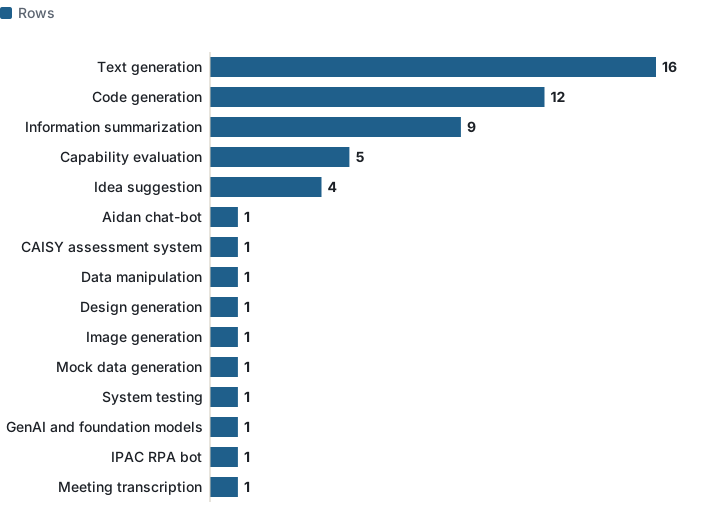
Federal Student Aid and the Office of Special Education and Rehabilitee Services (spelt as the file spells it) list 6 rows each, and 17 offices list at least one.[1]
The department's grant priority on AI, published as a final priority on 13 April 2026 after a proposal of 21 July 2025 that drew comments from "over 300 parties", lets any discretionary grant competition give preference to projects that integrate "AI literacy skills and concepts into teaching and learning", expand "age-appropriate AI and computer science education in K-12 education", or use AI for tutoring, teacher training and "classroom and school operations".[4] It is a funding priority, not a use of AI by the department, and the inventory does not count it.[4][3]
Data: ed-by-bureau-2025.csv · ed-columns-filled-2025.csv
The National Science Foundation
NSF's 17 rows are spread over 9 directorates and offices, with 2 deployed, 4 in pilot and 11 before deployment.[1] The deployed ones are "ServiceNow GenAI "Now Assist"", "Microsoft 365 (M365) AI Builder pre-built Generative Pre-trained Transformer (GPT) for Summarization".[1] The rows closest to the research process are proposal tools: a "Resubmit Checker" that scores a proposal's similarity to past submissions, a "Budget Area Topic Classification Tool" that sorts proposals into budget areas with a BERT model, two rows that mine reviewers' areas of expertise, and a project to make research progress reports "AI-ready".[1] NSF's own policy page lists the same 17 use cases, "Updated December 2025", beside its AI strategy and its compliance plan.[6]
| Bureau, as named in the file | Deployed | Pilot | Pre-deployment | Total |
|---|---|---|---|---|
| Directorate for Technology, Innovation, and Partnership (TIP) | 0 | 1 | 3 | 4 |
| Office of Integrative Activities (OIA) | 1 | 1 | 1 | 3 |
| Directorate of Engineering (ENG) | 0 | 0 | 2 | 2 |
| Office for Legislative and Public Affairs (OLPA) | 0 | 1 | 1 | 2 |
| Office of Information and Resource Management (OIRM) | 1 | 0 | 1 | 2 |
| Directorate for Biological Sciences (BIO) | 0 | 1 | 0 | 1 |
| Directorate for Computer and Information Science and Engineering (CISE) | 0 | 0 | 1 | 1 |
| Directorate for STEM Education (EDU) | 0 | 0 | 1 | 1 |
| Office of Chief Information Officer (OCIO) | 0 | 0 | 1 | 1 |
The National Artificial Intelligence Research Resource, which NSF leads for outside researchers, began as a pilot in 2024 and has supported "more than 600 research projects and 6,000 students", with 13 other federal agencies and 28 non-governmental partners, and the agency has released an opportunity to set up a NAIRR Operations Center to move it from pilot to "a sustained national capability".[5] The page also records that NSF is updating its wording to "super intelligence" under an executive order of 29 September 2026.[5]
Data: nsf-by-bureau-2025.csv
NIH and NASA
NIH's 31 grant-process rows are the largest deployed group in the set, with 14 deployed; 28 of the 31 are filed under administrative functions.[1] They refer applications to study sections and program officers, "Assisted Referral Tool (ART)", "Internal Referral Module (IRM)", "Study Section Clustering Tool (SSCT)", detect overlapping science and conflicts of interest, and in one pilot look for "Detection of AI-Generated Reviewer Critiques".[1]
NASA files 387 of its 425 rows under the topic "Science", of which 20 are deployed.[1] The narrower research-word rule keeps 42 of them, 4 deployed, among them the Jet Propulsion Laboratory's "AEGIS: Autonomous Exploration for Gathering Increased Science" and "Mars2020 Rover (Perseverance)", and 36 before deployment, which is where foundation models for the Moon, heliophysics and planetary science sit.[1]
The earlier version of this site ran seven general posts on AI in education, research and learning systems. They are retired; what a reader can check is the list above and the documents behind it.
Counting caveats
- OMB excludes basic and applied research from the inventory unless it is meant for agency use, so the set is about administering research and education, not doing research with AI.[3]
- The Department of Education's rows carry no stage, topic, classification or high-impact answer, so they cannot be compared with other agencies on those columns.[1]
- The NIH and NASA parts are word rules over two text columns; a grant tool that never says "grant" or "referral" is missed, and a NASA row that says "research" about an airport model is kept.[1]
- NSF's research resource, NAIRR, is an infrastructure program for outside researchers, not a use case of NSF's; its numbers come from NSF's page and are not in the inventory.[5]
- Topic, classification, stage and the high-impact answer are each one choice by the reporting agency.[2]
See also: AI in the public sector, Generative AI in government, AI in health, Data science in government, AI in culture and the arts, AI in public communications, and the data story 3,611 uses of AI on the federal list.
Sources
- Office of Management and Budget, 2025 Federal Agency AI Use Case Inventory, file of individually reported use cases (3,611 rows; the repository says "as of April 13, 2026"), counted by this site: 2025_individually_reported_AI_use_cases.csv. Read 28 October 2026.
- Office of Management and Budget, 2025 inventory data dictionary. Read 28 October 2026.
- Office of Management and Budget, 2025 Federal Agency AI Use Case Inventory repository, README (summary, submission schedule and exclusion criteria). Read 28 October 2026.
- U.S. Department of Education, Final Priority and Definitions: Secretary's Supplemental Priority and Definitions on Advancing Artificial Intelligence in Education, 91 FR 18774, 13 April 2026 (govinfo). Read 29 October 2026.
- U.S. National Science Foundation, National Artificial Intelligence Research Resource (program page, with "Two Years In: NAIRR by the Numbers"). Read 29 October 2026.
- U.S. National Science Foundation, Artificial Intelligence Policy and Strategy (policy page with the agency's AI use case inventory, "Updated December 2025"; page last updated 12 February 2026). Read 29 October 2026.
How this page was counted: one row per use case in OMB's file, read on 28 October 2026. A row is in the set when its agency column is exactly "ED" or "NSF"; when its agency_bureau column is "HHS/NIH" and its use_case_name or problem_solved column contains, as a whole word, case-insensitive, singular or plural, one of grant, grant application, peer review, reviewer, study section, referral, proposal, program officer; or when its agency column is "NASA" and the same columns contain one of research, researcher, scientist, scientific. Stages, topics, classifications and high-impact answers are those columns as given, with an empty cell counted as "no stage given", "no topic given" or "no answer". README.txt beside the CSV files repeats the rule.