Guide · Buildings and infrastructure
AI in buildings and infrastructure
Which federal AI use cases name buildings, facilities, dams or infrastructure, what GSA and HUD list, and what GSA's smart-buildings directive and DOE's buildings office say. Counted from the public inventory with a stated phrase rule.
The public record
Agencies list their AI use cases each year; OMB compiles the lists into one public file of 3,611 rows.[3][1] Buildings and infrastructure have no single agency in it. The General Services Administration owns and leases federal buildings through its Public Buildings Service; the Department of Housing and Urban Development funds housing; the Bureau of Reclamation and the Federal Energy Regulatory Commission inspect dams; and the Army Corps of Engineers, which runs levees, locks and dams, is part of the Department of War, as OMB's README names it (the Department of Defense), whose use cases the file excludes.[3] So this guide counts in two ways: every row of GSA and HUD, and rows anywhere in the file whose text names a building, a facility, a dam or infrastructure.[1]
The counting rule
A row is counted when its use_case_name or its problem_solved text contains, as a whole word or phrase and ignoring case, "buildings", "building energy", "building control", "building automation", "building management", "building systems", "Public Buildings Service", "real property", "facility" or "facilities" followed by management, managers, inspection, condition, maintenance or operations, "facilities improvement", "critical infrastructure", "infrastructure health", "infrastructure inspection", "infrastructure planning", "water", "energy", "transportation", "border", "physical", "civil" or "grid" followed by "infrastructure", "construction", "HVAC", "bridges", "bridge inspection", "dam" or "dams", "levee" or "levees", "structural health", "structural integrity", or "energy use of buildings".[1][2] The single words "building", "facility", "infrastructure" and "bridge" are not terms: in this file they appear in phrases such as building a model, a VA facility, IT infrastructure and a bridge call. The rule is a text match: it keeps "construction" when a row means constructing a map, and it misses a row about a boiler that uses none of the phrases. The matched rows are published beside this page with the phrases each one matched.[1]
How many, and where
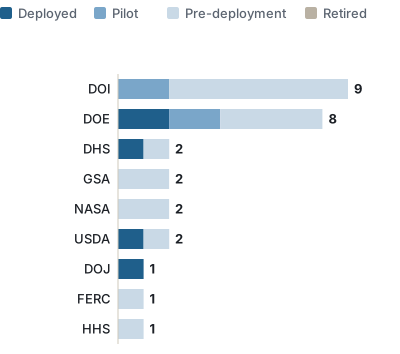
The rule matches 28 of the 3,611 use cases.[1] Of those, 5 are marked deployed, 4 are pilots and 19 are before deployment; none is retired.[1] So 18% of the matched rows are deployed, against 29% for the whole file.[1] The Department of the Interior has the largest share with 9, then the Department of Energy with 8; GSA itself has 2.[1] "Dam" or "dams" is in 4 rows and "construction" in 5; "HVAC" is in 1, and no row names a bridge or a levee.[1]
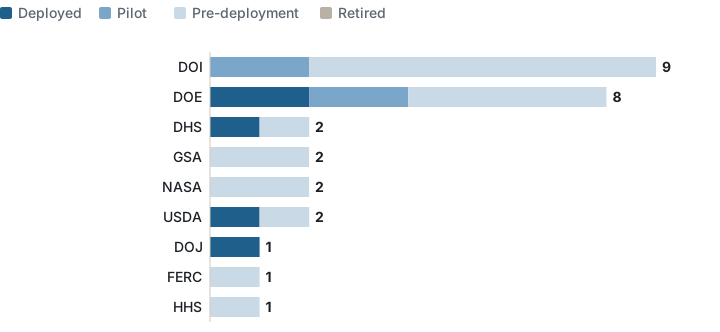
| Agency, as named in the file | Deployed | Pilot | Pre-deployment | Total |
|---|---|---|---|---|
| Department of the Interior | 0 | 2 | 7 | 9 |
| Department of Energy | 2 | 2 | 4 | 8 |
| Department of Homeland Security | 1 | 0 | 1 | 2 |
| General Services Administration | 0 | 0 | 2 | 2 |
| National Aeronautics and Space Administration | 0 | 0 | 2 | 2 |
| Department of Agriculture | 1 | 0 | 1 | 2 |
| Department of Justice | 1 | 0 | 0 | 1 |
| Federal Energy Regulatory Commission | 0 | 0 | 1 | 1 |
| Department of Health and Human Services | 0 | 0 | 1 | 1 |
Data: buildings-by-stage-2025.csv · buildings-by-term-2025.csv
What the rows describe
The dam rows are inspection and reporting tools: the Department of Agriculture's deployed "Dam Inspection Report Document Processing" and its "DamWatch automated leadership reporting" for storm impacts, the Bureau of Reclamation's seismic-risk statistics for dams, and FERC's tool to improve dam and pipeline safety inspections.[1] Of Interior's other 8 rows, four are crack mapping and structural health monitoring of concrete, corrosion classification from offshore platform surveys, a condition assessment of "real property assets", and a facilities repair project tool for Indian Affairs; the other 4, a quagga mussel habitat model, wildlife detection in aerial imagery, inland water quality from satellite imagery and Quaternary geologic mapping, match only on "water infrastructure" or "construction" and are not about buildings.[1] The Department of Energy's 8 include two deployed Pacific Northwest National Laboratory rows on building energy management and building control systems, a facilities visual inspection tool, and a dashboard on the integrity of offshore energy infrastructure.[1] The Bureau of Prisons' deployed "Building Automation Systems", which controls "a building's HVAC lighting and other systems", is one of 2 matched rows marked high-impact; the other is Oak Ridge's AI for experimental facilities operations.[1]
| Agency | Bureau | Use case, as named in the file | Stage | Phrases matched |
|---|---|---|---|---|
| DHS | CBP | Border Infrastructure Center of Excellence AI (BICE AI) | Pre-deployment | water, energy, transportation, border, physical or civil infrastructure |
| DHS | CISA | Critical Infrastructure Network Anomaly Detection | Deployed | critical infrastructure |
| DOE | LLNL - Lawrence Livermore National Laboratory (LFO) | Bernie-AI: Infrastructure Planning Support POC | Pilot | infrastructure planning |
| DOE | NE INL - NE Idaho National Laboratory (NE) | COREII | Pilot | critical infrastructure |
| DOE | NETL - National Energy Technology Laboratory (FECM) | Offshore AIIM Dashboard | Pre-deployment | water, energy, transportation, border, physical or civil infrastructure |
| DOE | NETL - National Energy Technology Laboratory (FECM) | Smart CO2 Transport-Route Planning Tool | Pre-deployment | construction |
| DOE | ORNL - Oak Ridge National Laboratory (SC43 OIM) | ORNL: AI for Experimental Facilities Operations | Pre-deployment | facility operations |
| DOE | PNNL - Pacific Northwest National Laboratory (SC43 OIM) | Adaptive Cyber-Physical Resilience for Building Control Systems | Deployed | building control |
| DOE | PNNL - Pacific Northwest National Laboratory (SC43 OIM) | Advancing Market-Ready Building Energy Management by Cost-Effective Differentiable Predictive Control | Deployed | building energy |
| DOE | PNNL - Pacific Northwest National Laboratory (SC43 OIM) | Facilities Visual Inspection | Pre-deployment | facility inspection |
| DOI | ASIA | Automate Project Execution of FI&R (Facilities Improvement and Repair) Projects | Pre-deployment | facilities improvement |
| DOI | BOR | Machine Learning Applied to Geotechnical Engineering: Statistical Methods Applied to Seismic Analysis [2024 INV#DOI-71 (NEW)] | Pre-deployment | dam, dams |
| DOI | BOR | Machine Learning Refines Quagga Habitat Suitability [2024 INV#DOI-74 (NEW)] | Pre-deployment | water, energy, transportation, border, physical or civil infrastructure |
| DOI | BOR | Using Machine Learning to Automate Crack Mapping and Structural Health Monitoring | Pre-deployment | infrastructure health; structural health or integrity |
| DOI | BSEE | Level 1 Survey Report Corrosion Level Classification | Pre-deployment | structural health or integrity |
| DOI | USGS | Automating the Detection and Classification of Wildlife in Aerial Imagery [2024 INV#WO0000000109409] | Pilot | water, energy, transportation, border, physical or civil infrastructure |
| DOI | USGS | Comprehensive Condition Assessment | Pre-deployment | real property |
| DOI | USGS | Random forest models for predicting water quality of inland waters from remotely sensed imagery | Pilot | water, energy, transportation, border, physical or civil infrastructure |
| DOI | USGS | Zero shot segmentation to expedite Quaternary geologic mapping [2024 INV#WO0000000108739; 2024 INV#WO0000000109150] | Pre-deployment | construction |
| DOJ | Department of Justice / FBOP | Building Automation Systems | Deployed | building automation; building management; HVAC |
| FERC | FERC | Improve Safety Inspections Use Case | Pre-deployment | dam, dams |
| GSA | National Computerized Maintenance Management System (NCMMS) AI Chatbot | Pre-deployment | facility management | |
| GSA | PBS AI Chatbot Domain Enhancements | Pre-deployment | buildings; Public Buildings Service; facility management | |
| HHS | HHS/CDC | Respirator Selection Logic (RSL) Copilot | Pre-deployment | construction |
| NASA | GSFC: Goddard Space Flight Center | Lunar Foundation Model | Pre-deployment | construction |
| NASA | MSFC: Marshall Space Flight Center | Autonomous Navigation Decision Making for Lunar/Martian Rovers | Pre-deployment | construction |
| USDA | Farm Production and Conservation | Dam Inspection Report Document Processing | Deployed | dam, dams |
| USDA | Farm Production and Conservation | DamWatch automated leadership reporting | Pre-deployment | dam, dams |
Data: buildings-use-cases-2025.csv
GSA, the landlord
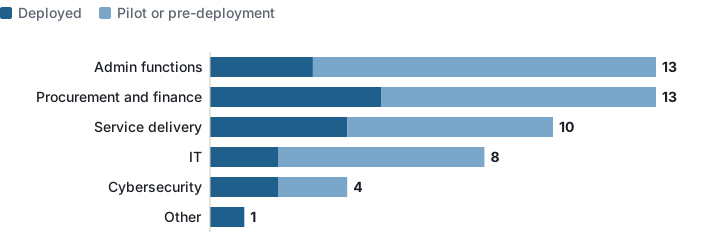
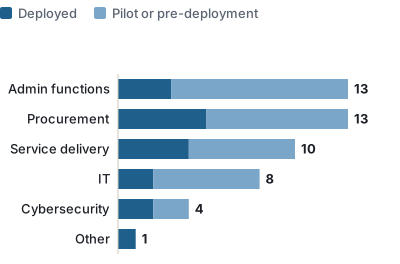
GSA lists 49 use cases, 17 deployed, 3 in pilot and 29 before deployment, and the file gives it no bureau column.[1] By topic they are administrative functions and procurement with 13 each, service delivery 10, IT 8 and cybersecurity 4.[1][2] Only 2 of the 49 match the rule, both before deployment: a chatbot for the Public Buildings Service's domains, among them facilities management and project delivery, and a chatbot for the maintenance management system used by facility managers.[1] Two more GSA rows concern real estate without matching: a space-booking tool and a generator of test-fit layouts.[1]
GSA's building technology sits outside the inventory. Its smart-buildings directive, signed in December 2021 and in force to December 2028, says the program "Starting around 2005" focused on advanced metering and fault detection and diagnostics, and that the directive covers building automation systems and device-based control systems across the federally owned buildings in GSA's custody.[4] A June 2024 release, now marked archived, announced $80 million from the Inflation Reduction Act for smart building technologies across "an estimated 560 federal buildings", with approximately 1,000 new meters, smart sensors and HVAC controls.[5] Neither document mentions AI.[4][5]
Data: gsa-by-stage-2025.csv · gsa-by-topic-2025.csv
HUD
HUD lists 11 use cases, 5 deployed and 2 retired, and none matches the rule.[1] Three are Ginnie Mae's, on counterparty risk and mortgage data; three are the Office of Housing's, two of them FHA Resource Center assistants; the other five are office tools, two of them retired.[1]
| Topic, as named in the file | Use cases | Of which deployed |
|---|---|---|
| Service Delivery | 3 | 1 |
| No topic given | 2 | 0 |
| Administrative functions | 2 | 0 |
| Other | 2 | 2 |
| Human resources | 1 | 1 |
| Procurement and financial management | 1 | 1 |
Data: hud-by-topic-2025.csv · hud-by-stage-2025.csv
The Department of Energy
The Building Technologies Office says it "conducts research, development, and demonstration activities" for building technology, and lists its program areas as thermal systems optimization, operations and energy systems optimization, construction technology and innovation, appliance and equipment standards, and strategic program management.[6] The office's own text does not mention AI (the department's site menu does, under its new name, "super intelligence"); the department's building rows in the inventory come from Pacific Northwest National Laboratory, not from this office.[6][1]
The earlier site's five general posts on AI in building, building design and building management systems, and two news items on construction and engineering, are retired.
Counting caveats
- The rule is a phrase match on two fields. "Construction" catches the construction of a geologic map and of a lunar model, and 4 of Interior's 9 rows, habitat, wildlife, water-quality and geologic-mapping work, are false positives that match only on "water infrastructure" or "construction"; a row about a boiler, a roof or a lease that uses none of the phrases is missed.[1]
- Department of War use cases are excluded from the file, so the Army Corps of Engineers' civil works are absent; its pages were not consulted.[3]
- The problem statement is required only for pre-deployment, pilot and deployed use cases, so a retired row can match on its name alone.[2]
- GSA's two building-related chatbots carry no high-impact answer in the file.[1]
- Stage, topic and the high-impact answer are each one choice by the reporting agency.[2]
See also: AI in engineering, AI in transportation, AI in government IT and cybersecurity, AI in the public sector, Generative AI in government, and the data story 3,611 uses of AI on the federal list.
Sources
- Office of Management and Budget, 2025 Federal Agency AI Use Case Inventory, file of individually reported use cases (3,611 rows; the repository says "as of April 13, 2026"), counted by this site: 2025_individually_reported_AI_use_cases.csv. Read 28 October 2026.
- Office of Management and Budget, 2025 inventory data dictionary. Read 28 October 2026.
- Office of Management and Budget, 2025 Federal Agency AI Use Case Inventory repository, README (summary, submission schedule and exclusion criteria). Read 28 October 2026.
- U.S. General Services Administration, GSA Smart Buildings, directive 7002.1 ADM, signed 16 December 2021 (directives library page). Read 29 October 2026.
- U.S. General Services Administration, news release, GSA Administrator announces $80 million for smart building technologies, 20 June 2024 (marked archived on the site). Read 29 October 2026.
- U.S. Department of Energy, Building Technologies Office, office page. Read 29 October 2026.
How this page was counted: one row per use case in OMB's file, read on 28 October 2026; a row matches the buildings rule when its use_case_name or problem_solved text contains, as a whole word or phrase and ignoring case, one of the phrases listed under "The counting rule" above; no agency is excluded. GSA rows are those whose agency column is exactly "GSA"; HUD rows those whose agency column is exactly "HUD". Stages, topics, classifications and high-impact answers are those columns as given, with an empty cell counted as "no stage given", "no topic given", "no classification given" or "no answer". The CSV files beside this page carry the counts, the source address and the read date; README.txt beside them repeats the rule in full.