Guide · Engineering
AI in engineering
Which federal AI use cases name engineering, simulation, digital twins or materials design, which NASA centers and national laboratories list them, and what NASA, the Department of Energy and NIST's Engineering Laboratory say about their own use of AI. Counted from the public inventory with a stated rule.
The public record
Federal agencies list their AI use cases each year and OMB compiles the lists into one public file of 3,611 rows.[3][1] Engineering is not a topic in that file; the agency chooses from a list in which science, IT and energy and environment are the nearest headings.[2] The government's engineering work sits in NASA's centers, the Department of Energy's laboratories, NIST, the FAA and the Bureau of Reclamation, and the file excludes the Department of War, as OMB's README names it (the Department of Defense), where military engineering would be listed.[3] So this guide looks at five agencies and counts the rows whose text names an engineering method.[1]
The counting rule
A row is counted when its agency is NASA, DOE, DOC, DOT or DOI, and its use_case_name or problem_solved text contains, as a whole word or phrase and ignoring case (a hyphenated compound such as "simulation-based" does not match), "engineering" (unless the word before it is prompt, software, feature, data, reverse, social or cloud), "engineering design", "simulation", "digital twin", "CAD", "computer-aided design", "finite element", "materials science", "materials discovery", "materials design", "new materials", "composite materials", "nanomaterial", "inverse design", "design optimization", "surrogate model", "structural health", "structural integrity", "structural analysis", "wind tunnel", "computational fluid dynamics", "aerodynamics", "thermal vacuum" or "molecular dynamics".[1][2] "Testing", "materials" and "engineer" on their own are not terms: in this file they appear in phrases such as software testing, genetic testing, training materials and the engineers who use a tool. The rule is a text match: it keeps a physics simulation and misses an engineering tool described without one of the words. The matched rows are published beside this page with the terms each one matched.[1]
How many, and where
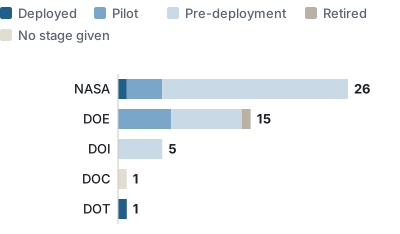
The five agencies list 1,305 of the 3,611 use cases, and the rule matches 48 of them.[1] Of those, 2 are marked deployed, 10 are pilots and 34 are before deployment; 1 is retired and 1 carries no stage.[1] So 4% of the matched rows are deployed, against 29% for the whole file.[1] NASA has 26 of the 48, the Department of Energy 15, the Department of the Interior 5, and Commerce and Transportation one each.[1] "Simulation" is the term in the largest share of rows, 19, then "engineering" in 12 and "digital twin" in 8; no row names CAD, a wind tunnel or computational fluid dynamics.[1]
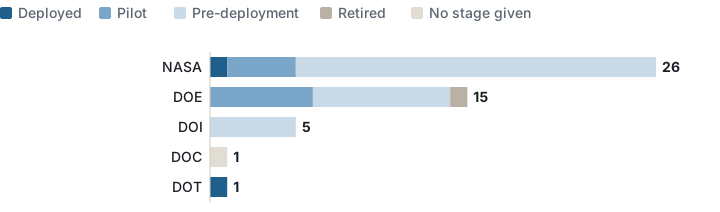
| Agency, as named in the file | Deployed | Pilot | Pre-deployment | Retired | No stage given | Matched | All of the agency's use cases |
|---|---|---|---|---|---|---|---|
| National Aeronautics and Space Administration | 1 | 4 | 21 | 0 | 0 | 26 | 425 |
| Department of Energy | 0 | 6 | 8 | 1 | 0 | 15 | 340 |
| Department of the Interior | 0 | 0 | 5 | 0 | 0 | 5 | 247 |
| Department of Commerce | 0 | 0 | 0 | 0 | 1 | 1 | 223 |
| Department of Transportation | 1 | 0 | 0 | 0 | 0 | 1 | 70 |
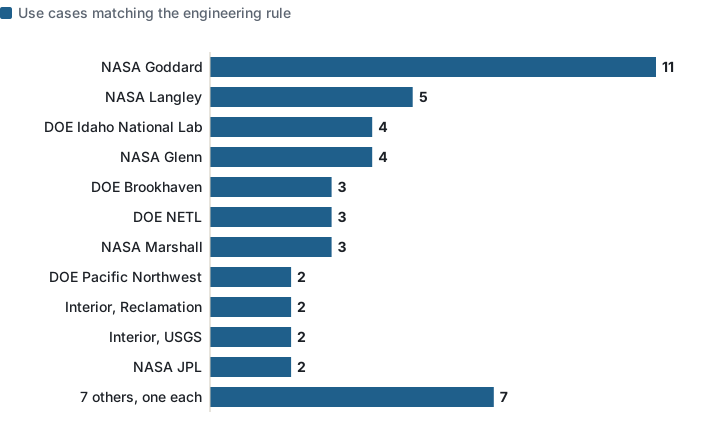
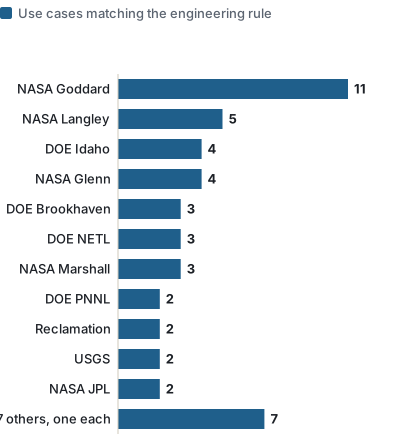
Within NASA, Goddard Space Flight Center lists 11 of the matched rows, Langley 5, Glenn 4 and Marshall 3; within the Department of Energy, Idaho National Laboratory lists 4, Brookhaven and the National Energy Technology Laboratory 3 each.[1]
Data: engineering-by-stage-2025.csv · engineering-by-term-2025.csv
What the rows describe
NASA's rows are design and simulation work: "Design Optimization of Turbomachinery Rotor Blades using Neural Network Surrogate Models" at Glenn, with a surrogate model standing in for the simulation; "Inverse Design of Materials", also at Glenn; a calibration framework for finite element modelling of metal additive manufacturing at Langley, with two molecular-dynamics accelerators; a liquid slosh surrogate model at Marshall; and at Goddard a climate digital twin, an uncertainty toolkit and "Text-to-Spaceship", which aims to turn requirements into design and manufacturability assessments.[1] The one deployed NASA row is the Perseverance rover, whose text names engineering for onboard autonomy and path planning.[1]
The Department of Energy's 15 are laboratory rows. Idaho National Laboratory's 4 pilots include two custom generative AI assistants for reactor engineers, "Custom GenAI for Advanced Reactor Development (RickoverAI)", "Custom GenAI for eVinci Microreactor Engineering (MauroGPT)", both marked high-impact, and a safeguards digital twin.[1] Oak Ridge's "ORNL: AI for Materials Science" is marked high-impact too, making 3 high-impact rows among the 48; Brookhaven lists nanomaterial discovery; the National Energy Technology Laboratory lists inverse design of polymers.[1] Interior's 5 include Reclamation's seismic statistics for dams and structural health monitoring of concrete.[1] By the classification the agencies chose, 33 of the 48 are classical machine learning and 7 generative AI.[1]
| Agency | Bureau | Use case, as named in the file | Stage | Terms matched |
|---|---|---|---|---|
| DOC | NOAA | Digital Twin for Earth Observations Using Artificial Intelligence | (no stage given) | digital twin |
| DOE | BNL - Brookhaven National Laboratory (SC43 OIM) | A Digital Twin for In-silico Spatiotemporally-resolved Experiments | Pre-deployment | digital twin |
| DOE | BNL - Brookhaven National Laboratory (SC43 OIM) | Accelerated Nanomaterial Discovery | Pre-deployment | new materials; nanomaterial |
| DOE | BNL - Brookhaven National Laboratory (SC43 OIM) | AI/ML for Applications in High Energy adn Nuclear Physics | Pre-deployment | simulation |
| DOE | FNAL - Fermi National Accelerator (SC43 OIM) | Denoising Diffusion to Accelerate Detector Simulation | Pilot | simulation |
| DOE | NE INL - NE Idaho National Laboratory (NE) | ACORN (Autonomous Operation for Reactor Technologies) | Pilot | simulation |
| DOE | NE INL - NE Idaho National Laboratory (NE) | Custom GenAI for Advanced Reactor Development (RickoverAI) | Pilot | engineering |
| DOE | NE INL - NE Idaho National Laboratory (NE) | Custom GenAI for eVinci Microreactor Engineering (MauroGPT) | Pilot | engineering |
| DOE | NE INL - NE Idaho National Laboratory (NE) | Safeguards Digital Twin | Pilot | digital twin |
| DOE | NETL - National Energy Technology Laboratory (FECM) | Creation of polymer datasets and inverse design of polymers with targeted backbones having High CO2 permeability and high CO2/N2 selectivity. | Pre-deployment | inverse design |
| DOE | NETL - National Energy Technology Laboratory (FECM) | IDAES-PSE | Pre-deployment | engineering |
| DOE | NETL - National Energy Technology Laboratory (FECM) | To use AI to calibrate the simulation model by matching simulation data with production history data. | Pre-deployment | simulation |
| DOE | ORNL - Oak Ridge National Laboratory (SC43 OIM) | ORNL: AI for Materials Science | Pre-deployment | materials science, discovery or design |
| DOE | PNNL - Pacific Northwest National Laboratory (SC43 OIM) | Microsoft Azure Quantum Elements | Pilot | materials science, discovery or design |
| DOE | PNNL - Pacific Northwest National Laboratory (SC43 OIM) | Surrogate models for probabilistic Bayesian inference | Pre-deployment | surrogate model |
| DOE | SLAC - SLAC National Accelerator Laboratory (SC43 OIM) | AI for system design optimization (e.g., detector, accelerator) | Retired | design optimization |
| DOI | BOR | Machine Learning Applied to Geotechnical Engineering: Statistical Methods Applied to Seismic Analysis [2024 INV#DOI-71 (NEW)] | Pre-deployment | engineering |
| DOI | BOR | Using Machine Learning to Automate Crack Mapping and Structural Health Monitoring | Pre-deployment | structural health, integrity or analysis |
| DOI | BSEE | Level 1 Survey Report Corrosion Level Classification | Pre-deployment | structural health, integrity or analysis |
| DOI | USGS | Predicting Sparse (Geothermal) Resources Availability by using Machine Learning [2024 INV#WO0000000109195] | Pre-deployment | engineering |
| DOI | USGS | Reinforcement Learning for Helmholtz Coil Operation and Simulation [2024 INV#WO0000000109497] | Pre-deployment | simulation |
| DOT | FAA AJO | Spectrum Assignment & Engineering Team LLM Document Search | Deployed | engineering |
| NASA | ARC: Ames Research Center | Distributed Spacecraft Autonomy | Pre-deployment | simulation |
| NASA | GRC: Glenn Research Center | Design Optimization of Turbomachinery Rotor Blades using Neural Network Surrogate Models | Pilot | simulation; design optimization; surrogate model |
| NASA | GRC: Glenn Research Center | Graph Neural Networks for Airfoil Performance Prediction | Pre-deployment | aerodynamics |
| NASA | GRC: Glenn Research Center | Inverse Design of Materials | Pre-deployment | new materials; inverse design |
| NASA | GRC: Glenn Research Center | Surrogate Models for Efficient Multiscale Modeling of Composite Materials | Pre-deployment | simulation; composite materials; surrogate model |
| NASA | GSFC: Goddard Space Flight Center | AI/ML for Anomaly Detection and Health Monitoring for the NSN | Pre-deployment | engineering |
| NASA | GSFC: Goddard Space Flight Center | Development of digital twin technologies for climate prediction | Pre-deployment | digital twin |
| NASA | GSFC: Goddard Space Flight Center | Diffusion Modeling of the Solar Corona | Pre-deployment | simulation |
| NASA | GSFC: Goddard Space Flight Center | Fast neural network emulator for vector radiative transfer simulations | Pre-deployment | simulation |
| NASA | GSFC: Goddard Space Flight Center | Machine learning for X-ray astronomical spectroscopy | Pre-deployment | simulation |
| NASA | GSFC: Goddard Space Flight Center | Mapping anthropogenic water cycle impacts in a future climate: A global digital twin for scenario-driven exploration | Pre-deployment | digital twin |
| NASA | GSFC: Goddard Space Flight Center | Nominal Forecast Sub System for the NASA Coastal Zone Digital Twin | Pre-deployment | digital twin |
| NASA | GSFC: Goddard Space Flight Center | Quantification of Uncertainty Analysis Toolkit (QUAnT) | Pilot | engineering; simulation; digital twin |
| NASA | GSFC: Goddard Space Flight Center | Roman Space Telecope WFI Pupil alignment verification | Pre-deployment | thermal vacuum |
| NASA | GSFC: Goddard Space Flight Center | Text-to-Spaceship | Pre-deployment | engineering |
| NASA | GSFC: Goddard Space Flight Center | XR Enabling Technologies for Hardware Integration & Test Process Improvement | Pre-deployment | engineering |
| NASA | JPL: Jet Propulsion Laboratory | AI Based Digital Twin Interoporability Schema | Pilot | simulation; digital twin |
| NASA | JPL: Jet Propulsion Laboratory | Mars2020 Rover (Perseverance) | Deployed | engineering |
| NASA | LaRC: Langley Research Center | Adaptive Neural Network Molecular Dynamics | Pre-deployment | simulation; molecular dynamics |
| NASA | LaRC: Langley Research Center | Atomistic Force Field Accelerator (ARFFA) | Pre-deployment | simulation; molecular dynamics |
| NASA | LaRC: Langley Research Center | Fast Machine Learning Lidar Surrogate Simulator: For Pristine Clear Sky | Pre-deployment | simulation |
| NASA | LaRC: Langley Research Center | Improving CERES Low-Latency Surface Radiation Fluxes with Machine/Deep Learning | Pre-deployment | simulation |
| NASA | LaRC: Langley Research Center | Probabilistic calibration framework for finite element thermal process modeling of metallic additive manufacturing. Application to promote certification/qualification of load critical aerospace flight parts. | Pre-deployment | finite element |
| NASA | MSFC: Marshall Space Flight Center | BoundState (Compliance & Risk Engine) | Pre-deployment | engineering |
| NASA | MSFC: Marshall Space Flight Center | Near-Reality Slosh Model using AIML | Pre-deployment | simulation; surrogate model |
| NASA | MSFC: Marshall Space Flight Center | RDUST Regolith Dust Universal System Tracker | Pilot | simulation |
Data: engineering-use-cases-2025.csv · engineering-by-classification-2025.csv
What the agencies say
NASA's AI page now carries the title "Super Intelligence" and says that under Executive Order 14434 of 29 September 2026 the agency "is working to update its communications" to use that term.[4] It says NASA's researchers and engineers "have safely used super intelligence for decades" and that 88% of the Perseverance rover's driving has been autonomous.[4] The page links to NASA's own use case inventory and to OMB's memoranda M-25-21 and M-25-22.[4]
The Department of Energy's page says the department has sponsored the applied mathematics and computer science behind AI "Since the 1960s", that its user facilities generate data such as "characterization of materials with X-rays and neutrons", and that it will build an integrated platform to "shrink discovery cycles from years to months".[5] It defines the technology as "machine-based systems that can make predictions, recommendations, or decisions".[5]
NIST's Engineering Laboratory describes its work as "measurement science, standards, and technology for engineered systems" and lists seven divisions and offices, among them intelligent systems, materials and structural systems, and fire research; its software list includes the Fire Dynamics Simulator, and its events list a workshop on "super intelligence in the fire service".[6] In the inventory NIST's rows are general tools, and none matches the rule.[1]
The earlier version of this site ran four general posts on AI and data science in engineering and predictive maintenance. They are retired; what a federal reader can check is the list above and the pages behind it.
Counting caveats
- The rule is limited to five agencies. The same terms match 17 rows elsewhere in the file, including a digital twin of a process at HHS and nursing simulation at VA; they are counted in the stage file for comparison and not in the 48.[1]
- "Simulation" catches physics and astronomy as well as engineering: Fermilab's detector simulation and Goddard's solar corona model are in the 48.[1]
- Department of War use cases are excluded from the file, so military and Army Corps engineering are absent by design.[3]
- AI used for basic or applied research is excluded unless it is meant for agency use, which limits what the laboratories and centers list.[3]
- Stage, classification and the high-impact answer are each one choice by the reporting agency.[2]
See also: AI in manufacturing, AI in buildings and infrastructure, AI in transportation, AI in defense, Data science in government, AI in the public sector, and the data story 3,611 uses of AI on the federal list.
Sources
- Office of Management and Budget, 2025 Federal Agency AI Use Case Inventory, file of individually reported use cases (3,611 rows; the repository says "as of April 13, 2026"), counted by this site: 2025_individually_reported_AI_use_cases.csv. Read 28 October 2026.
- Office of Management and Budget, 2025 inventory data dictionary. Read 28 October 2026.
- Office of Management and Budget, 2025 Federal Agency AI Use Case Inventory repository, README (summary, submission schedule and exclusion criteria). Read 28 October 2026.
- National Aeronautics and Space Administration, Super Intelligence (the agency's AI topic page, retitled under Executive Order 14434). Read 29 October 2026.
- U.S. Department of Energy, Super Intelligence (the department's AI topic page). Read 29 October 2026.
- National Institute of Standards and Technology, Engineering Laboratory, laboratory page. Read 29 October 2026.
How this page was counted: one row per use case in OMB's file, read on 28 October 2026; a row matches the engineering rule when its agency column is NASA, DOE, DOC, DOT or DOI and its use_case_name or problem_solved text contains, as a whole word or phrase and ignoring case, one of the terms listed under "The counting rule" above; a hyphen is not a word boundary here, so a hyphenated compound such as "simulation-based" does not match. Stages, topics, classifications and high-impact answers are those columns as given, with an empty cell counted as "no stage given", "no topic given", "no classification given" or "no answer". The CSV files beside this page carry the counts, the source address and the read date; README.txt beside them repeats the rule in full.