Guide · Manufacturing
AI in manufacturing
Which federal AI use cases name manufacturing, factories or supply chains, which agencies they belong to, and what NIST's manufacturing programs and the Department of Energy's manufacturing office say about themselves. Counted from the public inventory with a stated keyword rule.
The public record
Federal agencies list their AI use cases each year and OMB compiles the lists into one public file of 3,611 rows.[3][1] There is no manufacturing agency in that file. The government's manufacturing programs sit in the Department of Commerce, at NIST, and in the Department of Energy, and the file excludes the use cases of the Department of War, as OMB's README names it (the Department of Defense), which holds the defense industrial base.[3] So this guide counts rows by what they say rather than by who filed them: a use case whose name or stated problem names manufacturing, a factory, a supply chain, industrial activity, additive manufacturing or 3D printing.[1][2]
The counting rule
A row is counted when its use_case_name or its problem_solved text contains, as a whole word and ignoring case, a word beginning "manufactur", "factory", "factories", "supply chain", "supply chains", "industrial", "additive manufacturing" or "3D print" in any form.[1][2] "Additive" on its own is not a term, because it would catch a statistical method. The rule is a text match. It keeps rows that use a word in another sense, such as "Azure Data Factory", a software product, and it misses rows that describe factory work without one of the words. The matched rows are published beside this page with the terms each one matched.[1]
How many, and where
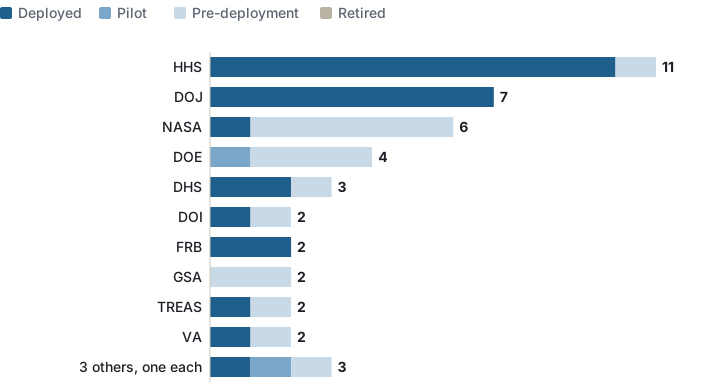
The rule matches 44 of the 3,611 use cases.[1] Of those, 26 are marked deployed, 2 are pilots and 16 are before deployment; none is retired.[1] So 59% of the matched rows are deployed, against 29% for the whole file.[1] The word "manufacturing" or one of its relatives appears in 25 rows and "supply chain" or "supply chains" in 18; "additive manufacturing" is in 2, "factory" in 1, and no row names 3D printing.[1]
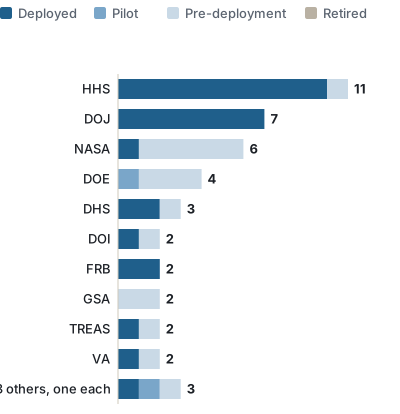
The Department of Health and Human Services has the largest share, 11 rows, 10 of them from the Food and Drug Administration, which regulates drug manufacturing.[1] The Department of Justice has 7, NASA 6, the Department of Energy 4 and the Department of Homeland Security 3; 3 agencies have one row each.[1] The Department of Commerce, which houses NIST, has none that match.[1]
| Agency, as named in the file | Deployed | Pilot | Pre-deployment | Total |
|---|---|---|---|---|
| Department of Health and Human Services | 10 | 0 | 1 | 11 |
| Department of Justice | 7 | 0 | 0 | 7 |
| National Aeronautics and Space Administration | 1 | 0 | 5 | 6 |
| Department of Energy | 0 | 1 | 3 | 4 |
| Department of Homeland Security | 2 | 0 | 1 | 3 |
| Department of the Interior | 1 | 0 | 1 | 2 |
| Federal Reserve Board | 2 | 0 | 0 | 2 |
| General Services Administration | 0 | 0 | 2 | 2 |
| Department of the Treasury | 1 | 0 | 1 | 2 |
| Department of Veterans Affairs | 1 | 0 | 1 | 2 |
| Environmental Protection Agency | 0 | 1 | 0 | 1 |
| National Science Foundation | 0 | 0 | 1 | 1 |
| Department of Agriculture | 1 | 0 | 0 | 1 |
Data: manufacturing-by-stage-2025.csv · manufacturing-by-term-2025.csv
What the rows describe
By the topic the agency chose, science leads with 10 rows, then health and medical with 9 and law enforcement with 7.[1][2] The FDA rows are regulatory: tools that read drug applications for the facilities named in them, a dashboard for the assessment of manufacturing sites, and "CDER Regulatory Science Research (RSR) Projects AI for Process Control in Advanced Manufacturing", filed under science.[1] The Department of Justice's 7 are a data-integration product at ATF, four Drug Enforcement Administration tools on where illicit drugs are made and moved, and two supply-chain risk tools.[1]
The rows that describe making things are fewer. NASA's 6 include "Identifying flaws in manufacturing of composites", a calibration framework for the thermal modelling of metal additive manufacturing, and a deployed robotic-arm toolpathing tool at Marshall Space Flight Center.[1] The Department of Energy's 4 are laboratory rows, among them "ORNL: AI for Advanced Manufacturing" at Oak Ridge, marked high-impact, and a Brookhaven project on guiding the synthesis of thin films.[1] The United States Mint lists predictive maintenance for its manufacturing equipment, before deployment, and the Federal Reserve Board a deployed "Manufacturer Sentiment Analysis".[1] 4 of the 44 matched rows are marked high-impact: the Oak Ridge row, two Justice license plate reader tools and a VA pharmacy inventory system.[1]
| Agency | Bureau | Use case, as named in the file | Stage | Terms matched |
|---|---|---|---|---|
| DHS | CBP | Entity Resolution | Deployed | supply chains |
| DHS | CBP | Forced Labor Virtual Consultant | Pre-deployment | supply chains |
| DHS | ICE | Entity Resolution for Global Trade Data | Deployed | supply chain |
| DOE | BNL - Brookhaven National Laboratory (SC43 OIM) | Autonomous, real-time guiding of BCP film synthesis | Pre-deployment | manufactur* |
| DOE | NE INL - NE Idaho National Laboratory (NE) | COREII | Pilot | supply chain |
| DOE | NETL - National Energy Technology Laboratory (FECM) | Data platform to expedite access and reuse of carbon ore data for materials, manufacturing and research | Pre-deployment | manufactur* |
| DOE | ORNL - Oak Ridge National Laboratory (SC43 OIM) | ORNL: AI for Advanced Manufacturing | Pre-deployment | manufactur* |
| DOI | USGS | Effects of vehicle traffic on space use and road crossings of caribou in the Arctic [2024 INV#WO0000000110111] | Deployed | industrial |
| DOI | USGS | Enhancing U.S. critical mineral supply chains through AI and remote sensing mapping of legacy mine sites and tailings | Pre-deployment | supply chains |
| DOJ | Department of Justice / ATF | Azure Data Factory | Deployed | factory |
| DOJ | Department of Justice / DEA | DEA Drug Signature Program Models | Deployed | manufactur* |
| DOJ | Department of Justice / DEA | LPR: Commercial Solution | Deployed | manufactur* |
| DOJ | Department of Justice / DEA | LPR: State Partner | Deployed | manufactur* |
| DOJ | Department of Justice / DEA | Supply Chain Analytics | Deployed | manufactur*; supply chain |
| DOJ | Department of Justice / JMD | Exiger Supply Chain Risk Management - DDIQ Due Diligence Analytics | Deployed | supply chain |
| DOJ | Department of Justice / JMD | Exiger Supply Chain Risk Management - DDIQ Research Engine | Deployed | supply chain |
| EPA | OECA | AI-Enhanced Facility Finder | Pilot | industrial |
| FRB | Division of Research and Statistics | Manufacturer Sentiment Analysis | Deployed | manufactur*; industrial |
| FRB | Division of Research and Statistics | Supply Chain Estimations | Deployed | supply chain |
| GSA | AI-Powered Visibility for Supply and Vendor Risk Resilience | Pre-deployment | supply chain | |
| GSA | Software Supply Chain Security Research | Pre-deployment | supply chain | |
| HHS | HHS/CDC | Site Audit AI Support (SAAIS) App | Pre-deployment | manufactur* |
| HHS | HHS/FDA/CDER | Analytics-Driven Supplement Evaluation (ASE) | Deployed | manufactur* |
| HHS | HHS/FDA/CDER | Annual Report CMC | Deployed | manufactur* |
| HHS | HHS/FDA/CDER | CDER Regulatory Science Research (RSR) Projects AI for Process Control in Advanced Manufacturing | Deployed | manufactur* |
| HHS | HHS/FDA/CDER | Quality Surveillance Dashboard (QSD) | Deployed | manufactur* |
| HHS | HHS/FDA/CDER | Regulatory Starting Material | Deployed | manufactur*; supply chain |
| HHS | HHS/FDA/CDER | 356H Machine Learning (ML) Facility Supply Chain Role Classification | Deployed | supply chain |
| HHS | HHS/FDA/CDER | Extracting DMF Facilities from unstructured documents | Deployed | manufactur* |
| HHS | HHS/FDA/CDER | Module 3 Facilities Extraction | Deployed | manufactur* |
| HHS | HHS/FDA/CDER | SCANS Facility Role Predictor | Deployed | manufactur* |
| HHS | HHS/FDA/CDRH | Supply Chain Resilience Program, Office of Supply Chain Resilience (OSCR) - Foresight | Deployed | supply chain |
| NASA | GRC: Glenn Research Center | Inverse Design of Materials | Pre-deployment | manufactur* |
| NASA | GSFC: Goddard Space Flight Center | Text-to-Spaceship | Pre-deployment | manufactur* |
| NASA | LaRC: Langley Research Center | Identifying flaws in manufacturing of composites | Pre-deployment | manufactur* |
| NASA | LaRC: Langley Research Center | Probabilistic calibration framework for finite element thermal process modeling of metallic additive manufacturing. Application to promote certification/qualification of load critical aerospace flight parts. | Pre-deployment | manufactur*; additive manufacturing |
| NASA | MSFC: Marshall Space Flight Center | Dirty Vacuum rated 6-Axis Robotic Arm Toolpathing | Deployed | manufactur*; additive manufacturing |
| NASA | MSFC: Marshall Space Flight Center | Object classification, change detection, and anomaly detection in LiDAR and other point cloud datasets. | Pre-deployment | manufactur* |
| NSF | Directorate for Computer and Information Science and Engineering (CISE) | Budget Area Topic Classification Tool | Pre-deployment | manufactur* |
| TREAS | Bureau of Engraving and Printing (BEP) | Inventory Replenishment Forecast | Deployed | supply chain |
| TREAS | United States Mint (USM) | AI-Driven Predictive Maintenance for Mint Manufacturing Equipment and Production Assets | Pre-deployment | manufactur* |
| USDA | Office Of Homeland Security | ARGUS AI Supply Chain Interference | Deployed | supply chain |
| VA | VHA: Veterans Health Administration | Pharmacy AI Managed Inventory System (PHAIMIS) | Pre-deployment | supply chain |
| VA | VHA: Veterans Health Administration | VA Supply Chain Knowledge Management Dashboard | Deployed | supply chain |
Data: manufacturing-use-cases-2025.csv · manufacturing-by-topic-2025.csv
NIST and Manufacturing USA
NIST appears in the inventory as a bureau of the Department of Commerce with 7 of the department's 223 rows, against 157 for NOAA.[1] All seven are general tools, "Google Gemini", "Grammarly", "Library Market Research GenAI Tools Pilot" and four others, and none carries a stage, a topic or a classification in the file.[1] None names manufacturing.[1]
NIST's manufacturing work is outside the inventory. Its Manufacturing Extension Partnership describes itself as a program of "nearly 1,400 trusted manufacturing advisors and experts" at more than 450 service locations, and its page announces a $40 million pilot in two areas, additive manufacturing and critical minerals, with a funding opportunity "expected to be announced later in 2026".[4] Manufacturing USA, the network of institutes whose program office is at NIST, lists 18 institutes; its technology filter tags two of them under "Super Intelligence", one under "Digital Twins" and three under "Modeling and Simulation", and the robotics institute's description names "software and artificial intelligence" among its disciplines.[5]
The Department of Energy
The Department of Energy's Advanced Materials and Manufacturing Technologies Office says its mission is "to drive and inspire innovation to transform materials and manufacturing" for secure supply chains, and that it is a suboffice of the Office of Critical Minerals and Energy Innovation; its newsletter page names three sister offices, for advanced mining and mineral production, manufacturing deployment, and analysis and strategy.[6] Its three programs are secure material supply chains, next-generation materials and processes, and energy technology manufacturing and workforce.[6] The office's own text on the page does not mention AI (the department's site menu does, under its new name, "super intelligence"); the department's matched inventory rows come from its national laboratories, not from this office.[6][1]
The earlier version of this site ran six general posts on factories, product design, robotics and predictive maintenance. They are retired; what a federal reader can check is the list above and the pages behind it.
Counting caveats
- The rule is a text match on two fields. "Azure Data Factory" matches "factory" and a caribou study matches "industrial"; a row about shop-floor work that uses none of the words is missed.[1]
- Department of War use cases are excluded from the file, so defense manufacturing is absent by design.[3]
- The problem statement is required only for pre-deployment, pilot and deployed use cases, so retired rows can match on their name alone.[2]
- AI used for basic or applied research is excluded unless it is meant for agency use, which limits what the national laboratories list.[3]
- Stage, topic and the high-impact answer are each one choice by the reporting agency.[2]
See also: AI in engineering, AI in mining and critical minerals, AI in defense, AI in food safety, AI in the public sector, Generative AI in government, and the data story 3,611 uses of AI on the federal list.
Sources
- Office of Management and Budget, 2025 Federal Agency AI Use Case Inventory, file of individually reported use cases (3,611 rows; the repository says "as of April 13, 2026"), counted by this site: 2025_individually_reported_AI_use_cases.csv. Read 28 October 2026.
- Office of Management and Budget, 2025 inventory data dictionary. Read 28 October 2026.
- Office of Management and Budget, 2025 Federal Agency AI Use Case Inventory repository, README (summary, submission schedule and exclusion criteria). Read 28 October 2026.
- National Institute of Standards and Technology, Manufacturing Extension Partnership (MEP), program page. Read 29 October 2026.
- Manufacturing USA (the program office is at NIST), Institutes, the list of institutes with its technology filters. Read 29 October 2026.
- U.S. Department of Energy, Advanced Materials and Manufacturing Technologies Office, office page. Read 29 October 2026.
How this page was counted: one row per use case in OMB's file, read on 28 October 2026; a row matches the manufacturing rule when its use_case_name or problem_solved text contains, as a whole word and ignoring case, a word beginning "manufactur", "factory", "factories", "supply chain", "supply chains", "industrial", "additive manufacturing" or "3D print" in any form; no agency is excluded. NIST rows are those whose agency_bureau is exactly "NIST". Stages, topics, classifications and high-impact answers are those columns as given, with an empty cell counted as "no stage given", "no topic given", "no classification given" or "no answer". The CSV files beside this page carry the counts, the source address and the read date; README.txt beside them repeats the rule.